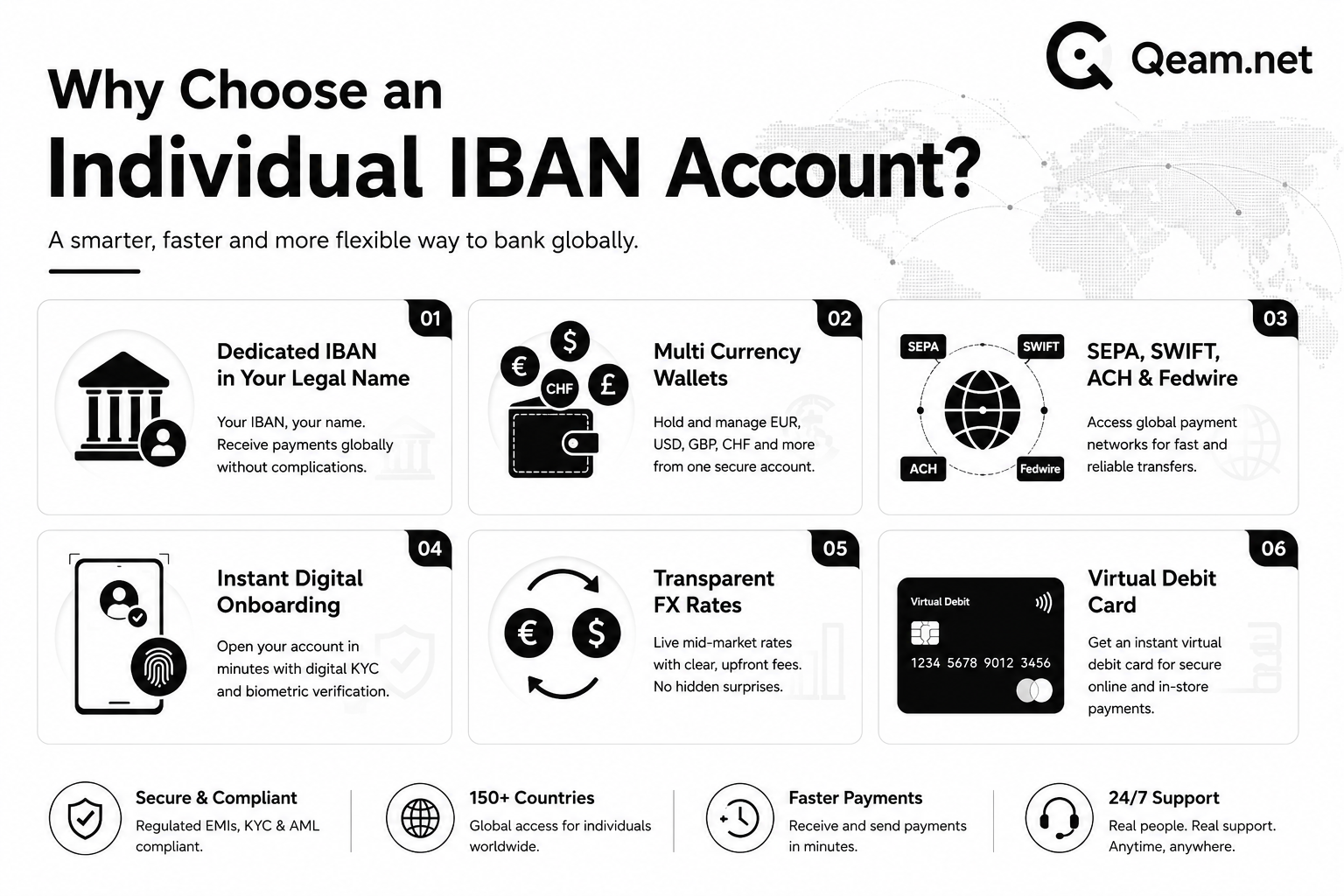
Opening a bank account while living, working, or travelling internationally has traditionally involved unnecessary friction. Many banks require branch visits, proof of local residency, lengthy identity checks, and expensive international transfers before you can even receive your first payment.
A dedicated Individual IBAN account removes many of these barriers by providing a personal account issued in your own legal name with access to major international payment networks including SEPA, SWIFT and, where available, domestic US payment rails. Instead of relying on shared pooled accounts, you receive dedicated banking details that employers, clients and financial institutions can recognise as belonging to you.
For freelancers, expatriates, remote employees, digital nomads and international students, this means faster salary payments, simpler cross border transfers, transparent foreign exchange pricing and the ability to hold multiple currencies from a single account.
What Is an Individual IBAN Account?
An Individual IBAN account is a personal bank account identified by a unique International Bank Account Number issued in your own legal name. It allows you to receive, hold, convert and send money internationally through regulated banking networks such as SEPA and SWIFT while managing multiple currencies from one account.
Unlike pooled fintech accounts that use internal reference numbers, a dedicated Individual IBAN identifies you as the account holder, making it easier for employers, clients and payment providers to verify incoming and outgoing payments.
In simple terms:
Personal account issued in your legal name
Dedicated IBAN for receiving international payments
Multi currency support
Compatible with SEPA and SWIFT
Suitable for salaries, freelance payments, personal transfers and everyday banking
Dedicated IBAN vs. Pooled Sub-Accounts
Not all "IBANs" offered by fintech are created equal. Many popular money transfer services issue pooled sub-accounts — a shared omnibus account at the provider level, with your name attached only as a reference field in their internal system. This structure can introduce compliance friction: incoming payments referencing the wrong details get delayed or bounced, and some corporate payers flag pooled accounts during vendor onboarding.
A dedicated Individual IBAN, by contrast, is issued directly in your legal name at the account level. Employers, clients, and landlords see your name as the account holder, not a reference code — which materially reduces payment rejection and reconciliation delays.
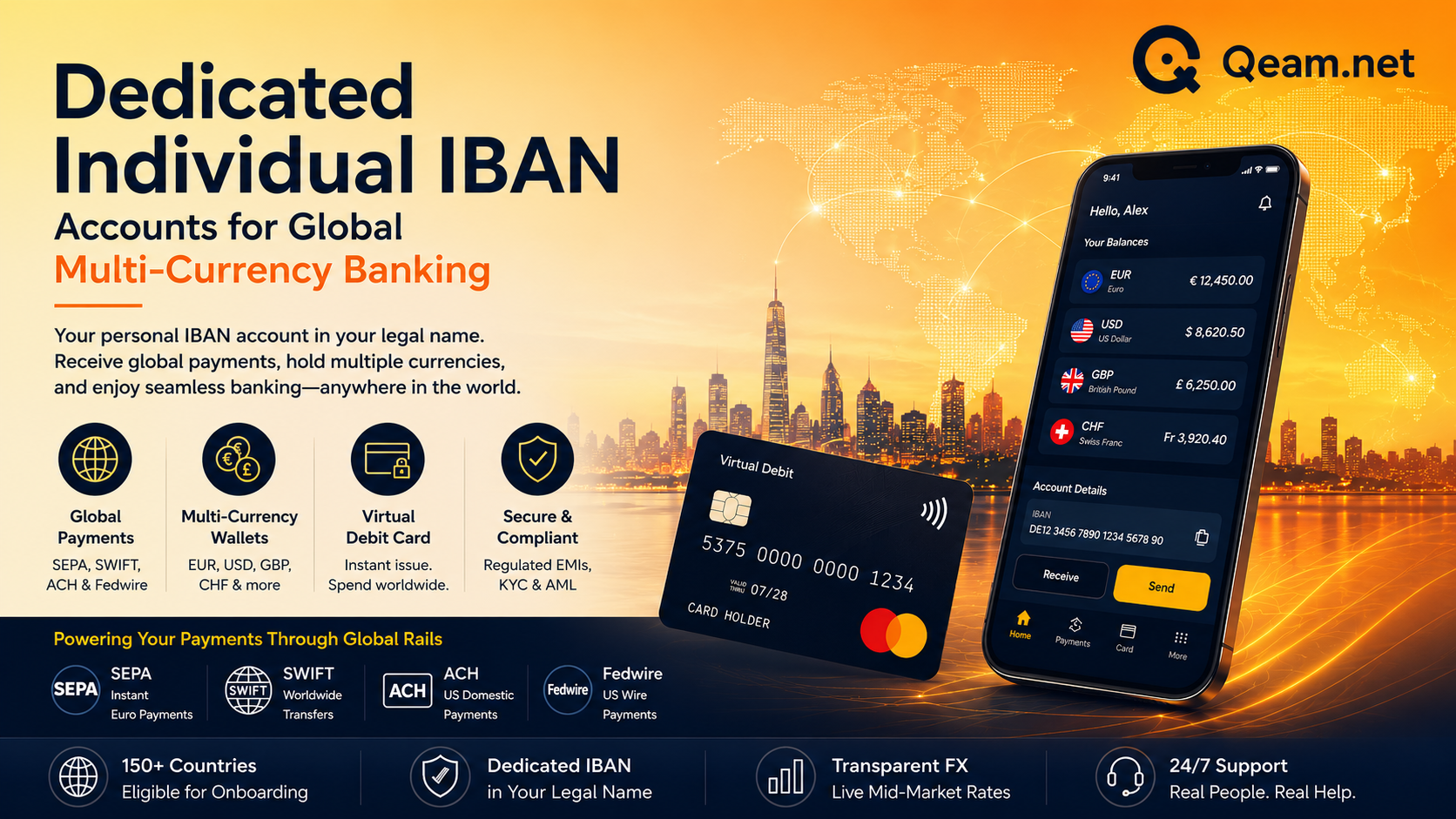
Multi-Currency Wallet Balances (EUR, USD, GBP, CHF)
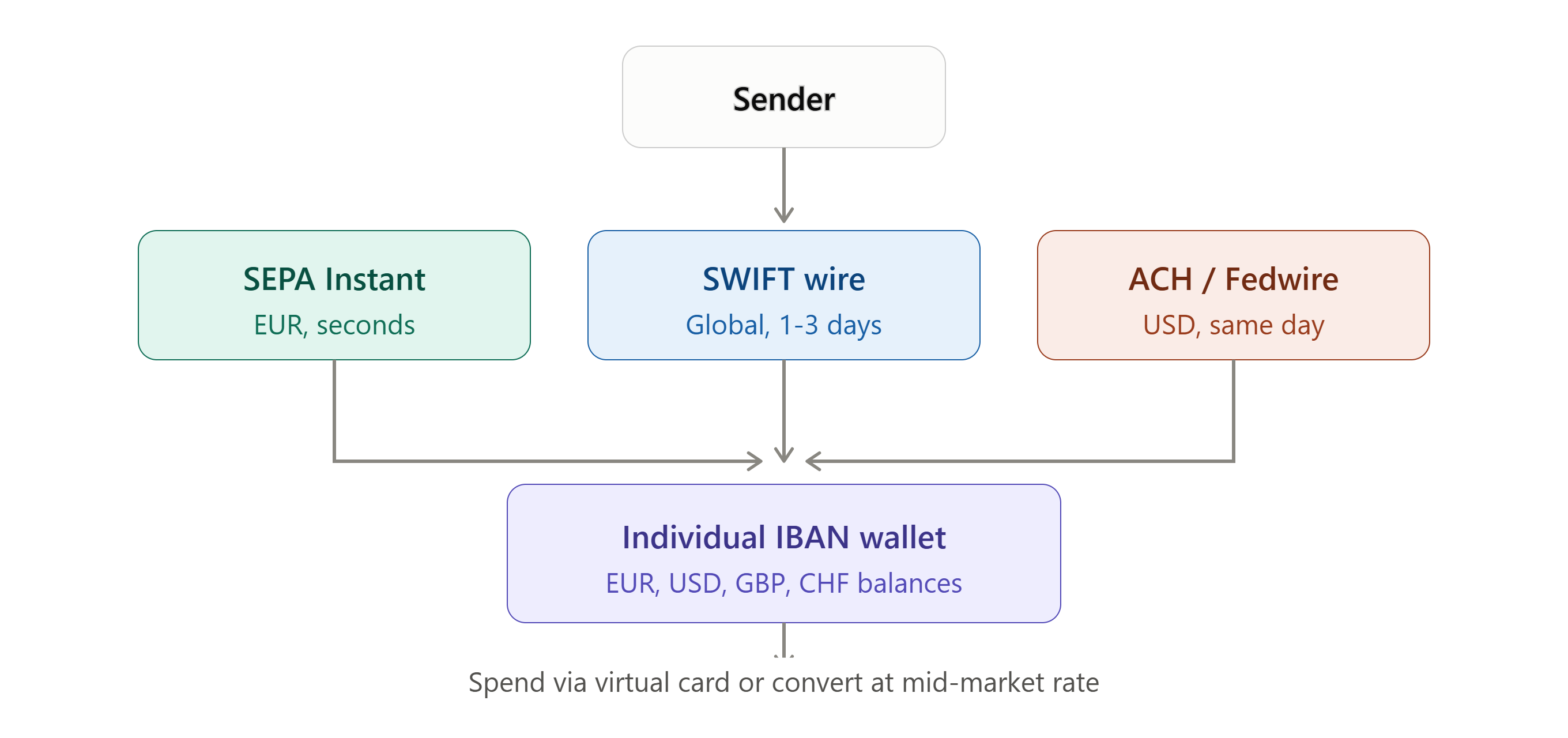
A single dashboard holds separate wallet balances in major currencies — EUR, USD, GBP, and CHF — so you can receive income in its original currency and decide when (or whether) to convert it, rather than being forced into an unfavorable same-day FX rate.
Global Payment Rails Integration
Underneath the dashboard sits access to the actual clearing networks that move money: SEPA Instant Credit Transfer (SCT Inst) for near-real-time euro payments across the EEA, SWIFT for global wire transfers, and US ACH / Fedwire for domestic dollar payments. That rail coverage is what determines whether your incoming salary or invoice clears in seconds or in days.
Who Should Open an Individual IBAN Account?
A dedicated Individual IBAN is particularly useful if you regularly receive or send money internationally.
It is commonly used by:
Digital nomads working across multiple countries
Freelancers invoicing overseas clients
Remote employees paid by international companies
Expats relocating within Europe
International students receiving family support
Content creators earning platform payouts
Investors receiving international distributions
Frequent travellers managing multiple currencies
If all of your income and spending occurs within one country, a domestic current account may be sufficient. However, if you regularly deal with more than one currency or banking system, an Individual IBAN can significantly reduce payment complexity.
Core Capabilities: Legal-Name IBANs, Multi-Currency Wallets & Virtual Debit Cards
Account Issued Under Your Legal Name
Because the account carries your legal name rather than a shared reference, it's recognized across 80+ countries for salary payments, invoice settlements, and personal remittances — the same way a domestic account would be.
Instant Digital KYC & Biometric Verification
Onboarding is designed to be completed in minutes, not days. You upload a passport or government-issued photo ID, complete a short biometric selfie check, and the system verifies your identity automatically — no in-branch appointment required.
Virtual Debit Card Pairing
Once your IBAN is active, you can pair it with an instantly issued virtual Mastercard debit card, ready for Apple Pay and Google Pay, usable for both online and in-store contactless payments.
Transparent Live Mid-Market FX Rates
Currency conversion happens at the live, real-time mid-market rate, with an explicit, low-margin fee shown before you confirm — a sharp contrast to the 2–4% hidden markups still common at traditional retail banks.
What to Check Before Choosing an Individual IBAN Provider
Not every provider offers the same level of banking infrastructure. Before opening an account, compare the following factors:
What to Check Before Choosing an Individual IBAN Provider
Not all Individual IBAN providers offer the same banking infrastructure, so it is important to compare their features before opening an account. Start by confirming that the provider issues a dedicated IBAN in your legal name, as this helps reduce payment verification and reconciliation issues. Check whether your country of residence is supported and whether the account offers the currencies you need, such as EUR, USD, GBP, or CHF.
If you regularly send or receive international payments, look for access to payment networks such as SEPA Instant for faster euro transfers, SWIFT for global transactions, and, where available, ACH or Fedwire for domestic US dollar payments. Compare foreign exchange pricing to ensure conversion fees are transparent and competitive, and consider whether the provider offers virtual debit cards for immediate online and contactless spending.
It is also worth reviewing how customer funds are safeguarded, whether the provider operates under recognised regulatory licences, and the quality of its mobile banking app for day to day account management. Finally, evaluate the availability and responsiveness of customer support, as timely assistance can make a significant difference when resolving payment or account related issues.
Real-World Use Cases
1. The European Expat & Cross-Border Employee
Scenario: An employee relocating to Germany or Spain needs to receive a EUR salary from a local employer and pay rent — before they have a utility bill to prove local residency.
Solution: They open a dedicated EUR IBAN online in about three minutes via digital KYC, receive their salary through SEPA Instant, and set up rent direct debits without needing a local proof-of-address document.
2. The Global Freelancer & Contractor
Scenario: A software engineer based in South America bills US tech clients in USD and European clients in EUR.
Solution: USD arrives via ACH/Fedwire and EUR via SEPA, landing in separate currency wallets. Funds convert at live mid-market rates only when needed, avoiding the 2–3% markups many traditional banks quietly apply on incoming foreign wires.
3. The Frequent Traveller & Digital Nomad
Scenario: A digital nomad moving between countries faces high international card fees and weekend currency spreads on ordinary purchases.
Solution: They hold EUR, GBP, and USD balances simultaneously and spend locally through a paired virtual debit card, without the foreign transaction surcharges typical of a single-currency home account.
Individual IBAN vs. Traditional Banks and Neo-Banks
Individual IBAN vs. Traditional Banks and Neo Banks
Traditional retail banks generally provide accounts issued in the customer's legal name, but they often require proof of local residency, in person branch visits, and onboarding that can take several days or even weeks. Foreign exchange services may include hidden margins of 2 to 4 percent alongside additional wire transfer fees, and international payments often rely on slower clearing systems. If you later need a business account, you will usually have to complete a separate corporate application process.
Popular neo banks such as Wise and Revolut offer a faster, digital first experience with automated onboarding. However, depending on the product and jurisdiction, some accounts may use pooled or sub account structures rather than a dedicated IBAN issued directly in your legal name. While they generally provide competitive foreign exchange rates, weekend markups or corridor specific limitations may apply. Business account upgrades are available but can be subject to eligibility requirements, account limits, or additional verification.
A dedicated Individual IBAN account combines the convenience of digital onboarding with the recognition of an account issued in your own legal name. Depending on the provider, eligible customers can complete KYC verification in minutes, access multi currency wallets, receive payments through SEPA Instant, SWIFT, and in some cases US ACH or Fedwire, and benefit from transparent mid market exchange rates with clearly disclosed fees. For users who later establish a registered business, many platforms also offer a straightforward transition to a Corporate IBAN without restarting the entire verification process.
Which option is best?
Traditional banks remain suitable for customers who only bank domestically and require branch services.
Neo banks generally offer excellent user experience but may rely on pooled account structures depending on the jurisdiction and product.
A dedicated Individual IBAN is often the strongest option for internationally mobile individuals who prioritise recognised account ownership, multi currency banking and global payment compatibility.
Common Misconceptions About Individual IBAN Accounts
Common Misconceptions About Individual IBAN Accounts
Myth: Every fintech account provides a dedicated IBAN.
Reality: Some providers use pooled accounts with virtual references instead of dedicated legal name IBANs.
Myth: An IBAN only works within Europe.
Reality: While IBAN originated in Europe, IBAN accounts can send and receive payments globally using networks such as SWIFT.
Myth: Multi currency banking always means automatic currency conversion.
Reality: Most modern platforms allow you to hold balances in different currencies and choose when to convert funds.
This is strong Information Gain because relatively few competitor articles address these misconceptions.
Individual IBAN vs. Corporate IBAN: Choosing the Right Account
When to Use an Individual IBAN
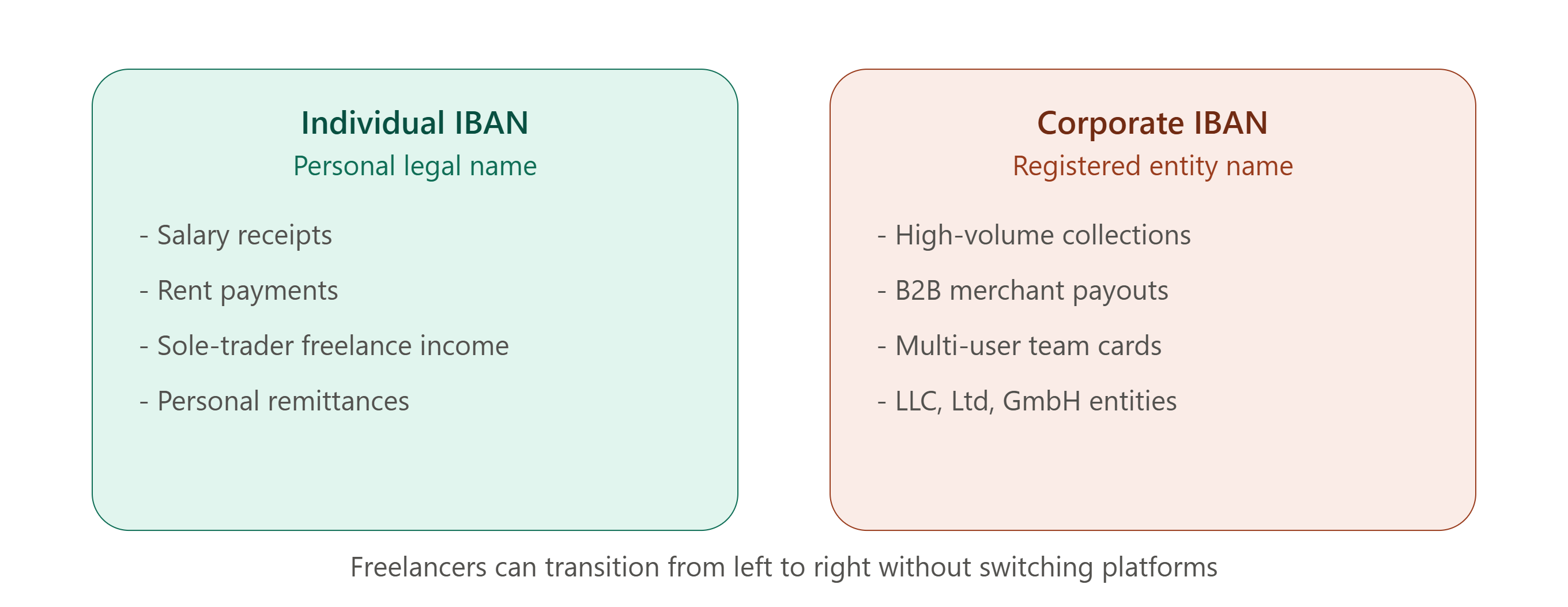
An Individual IBAN fits personal salary receipts, rent payments, freelance income earned as a sole trader, and personal remittances — any activity tied to you as an individual rather than a registered business.
When to Upgrade to a Corporate IBAN
Once you incorporate — as an LLC, Ltd, or GmbH — a Corporate IBAN becomes the appropriate rail. It supports higher-volume collection accounts, B2B merchant payouts, and multi-user team card issuance that an individual account isn't built for.
Moving From Personal to Business Without Switching Providers
Freelancers who scale into an incorporated business can typically transition from a personal account to a corporate one within the same platform, carrying over verification history rather than restarting onboarding from zero.
How to Open Your Individual IBAN Online
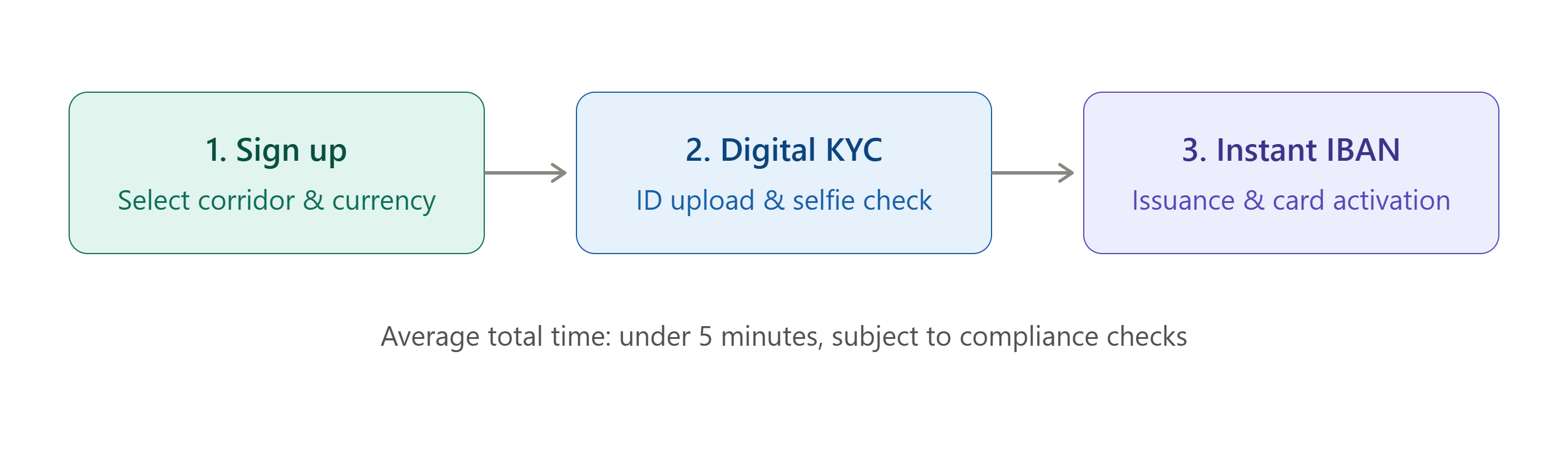
Digital sign-up & corridor selection — Choose your residency corridor and preferred primary currency (EUR, USD, or GBP).
Automated KYC verification — Upload a valid passport or government photo ID and complete a short biometric selfie check.
Instant IBAN issuance & card activation — Receive your personal IBAN immediately upon approval, pair a virtual debit card, and start transacting.
Account Transfer Limits, Daily Caps & Fee Transparency
Multi-currency accounts typically apply tiered transfer limits rather than a single flat cap — commonly structured around daily and monthly thresholds (for example, in the region of €10,000 per day and €50,000 per month), with higher tiers unlocked as additional verification is completed. Reputable providers also commit to no inactivity fees on dormant balances, which matters for anyone holding a currency wallet they don't touch every month. Always confirm current limit tiers and fee schedules directly on the provider's pricing page, since these figures are adjusted periodically.
Tax Compliance, CRS & FATCA Financial Reporting Disclosures
Because Individual IBAN accounts are opened by non-residents across many jurisdictions, they fall within international tax transparency frameworks. Two frameworks matter most:
OECD Common Reporting Standard (CRS): An international agreement under which financial institutions collect and report account holder tax residency information, sharing it annually with the relevant tax authorities of participating countries.
FATCA (Foreign Account Tax Compliance Act): A US law requiring foreign financial institutions to report accounts held by US persons to the IRS.
In practice, this means account opening includes a tax residency self-certification step, and your account provider may report account details to your declared tax residency's authorities. This is standard practice across regulated EMIs and banks — not something unique to any single provider — and it doesn't replace your own obligation to file taxes correctly in your country of residence.
Regulatory Disclosures & Deposit Safeguarding
European Economic Area (EEA) Partner EMI Safeguarding
EUR accounts are generally issued by regulated Electronic Money Institutions (EMIs) or partner banks operating within the EEA. Client funds are held in segregated safeguarding accounts at tier-1 central or commercial banks, separate from the provider's own operating funds.
US FDIC Partner Banking Coverage
USD accounts are typically issued through US banking partners, offering pass-through FDIC insurance eligibility up to applicable legal limits — meaning the insurance coverage flows through the partner bank rather than the fintech itself.
Mastercard® Licensed Virtual Card Issuance
Virtual debit cards are issued by licensed program partners under official authorization from Mastercard® International, and transactions are protected by standard 3D Secure 2.0 authentication and PCI-DSS compliant processing infrastructure.
Frequently Asked Questions
Who can open an Individual IBAN account online? Any individual aged 18 or over, residing in one of 150+ eligible countries, can typically complete digital onboarding with a valid passport or government photo ID in a matter of minutes.
What is the difference between an Individual IBAN and a Corporate IBAN? An Individual IBAN is issued in a personal legal name for personal transactions, while a Corporate IBAN is issued in a registered business entity's name for invoicing, payroll, and corporate payments.
Is my money safe in an Individual IBAN account? EUR funds are generally safeguarded in segregated accounts at regulated EEA partner financial institutions in accordance with EU electronic money regulations, and USD funds are typically eligible for pass-through FDIC coverage via a partner bank.
Can I receive international salary in USD and GBP into my IBAN? Yes. Multi-currency accounts commonly provide dedicated wallet credentials supporting EUR (SEPA/SEPA Instant), USD (ACH/Fedwire), and GBP (Faster Payments).
How long does KYC verification take for a personal IBAN? Automated digital KYC typically takes between two and five minutes, with the personal IBAN activated immediately upon approval.
Can non-residents get an EU IBAN without a European proof of address? Yes. Through partner EMI global onboarding frameworks, non-residents with valid international identity documentation can generally register for an EU EUR IBAN without a local utility bill.
What are the daily and monthly transfer limits on an Individual IBAN? Limits are usually tiered, with an initial cap (commonly in the range of a few thousand euros daily) that increases as you complete additional verification steps — check the specific provider's published limits for exact figures.
Do I need to report my Individual IBAN account for tax purposes? Under CRS and, where applicable, FATCA, your account provider will collect a tax residency self-certification and may report account information to relevant tax authorities; you remain responsible for your own tax filings.
Can freelancers use an Individual IBAN to invoice clients paying via crypto exchanges? Yes — many freelancers use their Individual IBAN as the fiat off-ramp for payouts from exchanges such as Coinbase or Kraken, receiving converted funds via standard SEPA or SWIFT transfer once the exchange processes the withdrawal.
Related Banking Services
Scaling into a registered business? Consider upgrading to a dedicated Corporate IBAN.
Need to spend online immediately? Add a virtual debit card for instant online spending.
Open Your Individual IBAN Account Today
A dedicated Individual IBAN combines the familiarity of a traditional bank account with the flexibility of modern digital banking. You can receive international payments in your own legal name, manage multiple currencies from a single dashboard, access major payment networks including SEPA and SWIFT, and benefit from transparent foreign exchange pricing without unnecessary banking complexity.
If you regularly work, travel or earn income across borders, an Individual IBAN can provide a simpler and more efficient way to manage your international finances. Complete digital onboarding, verify your identity through standard compliance checks, and begin using your account once approved.