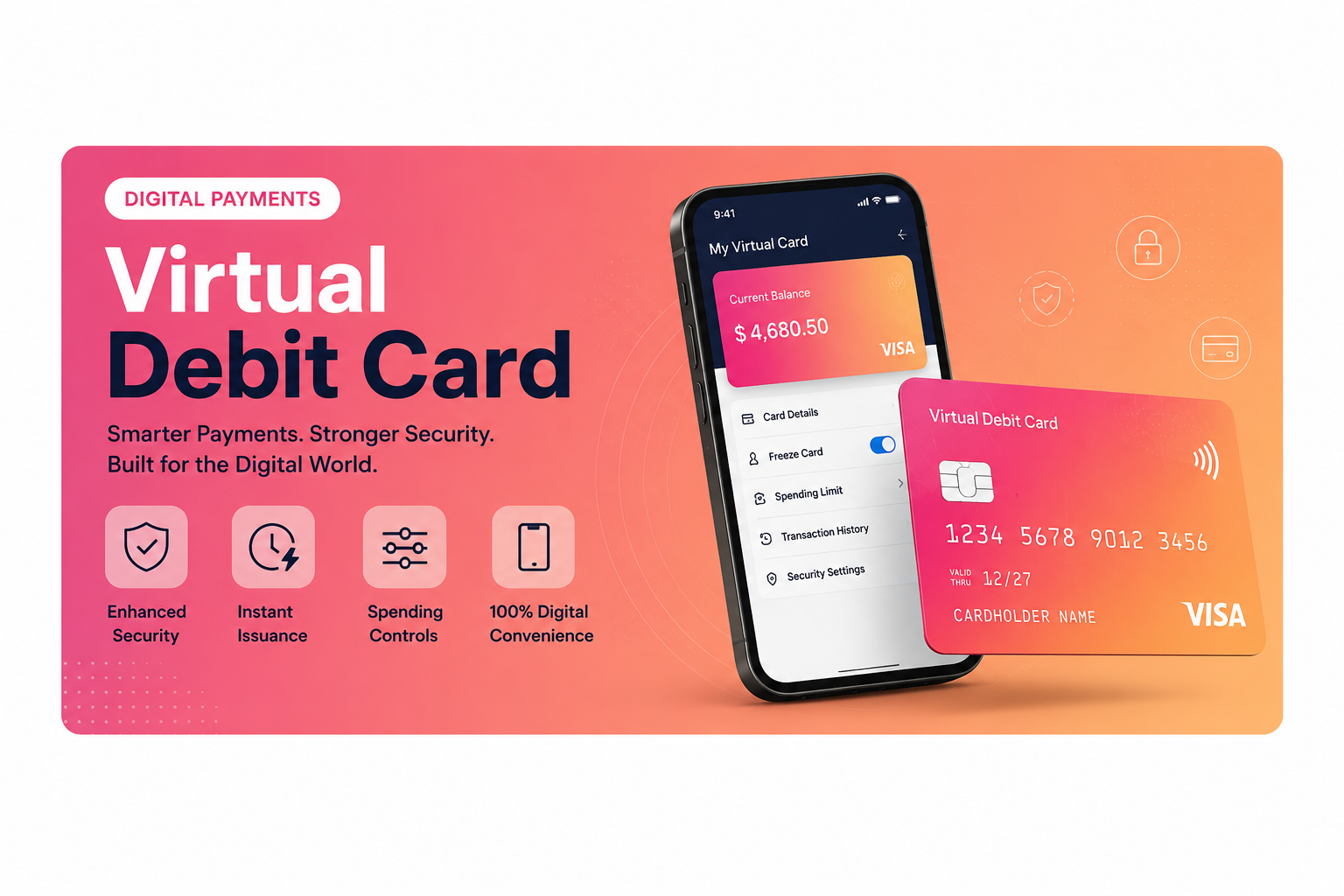
A virtual debit card online is an instantly generated 16-digit payment card tied to a pre-funded, multi-currency sub-ledger (USD, EUR, GBP). Built on PCI-DSS Level 1 tokenized infrastructure with Tier-1 US and EU BINs, it supports custom spend limits, 3DS v2.2 authentication, and near-zero foreign exchange spreads. Platforms like Qeam.net issue these cards in under a minute, without a physical card or a trip to a branch.
This guide covers how the technology works, why it beats a traditional bank debit card for cross-border spending, and how to choose (and set up) a provider correctly.
1. What Is a Virtual Debit Card and How Does Cloud-Based Card Generation Work?
Definition: A virtual debit card is a card number, expiry date, and CVV generated entirely in software, funded from a digital wallet rather than a linked checking account.
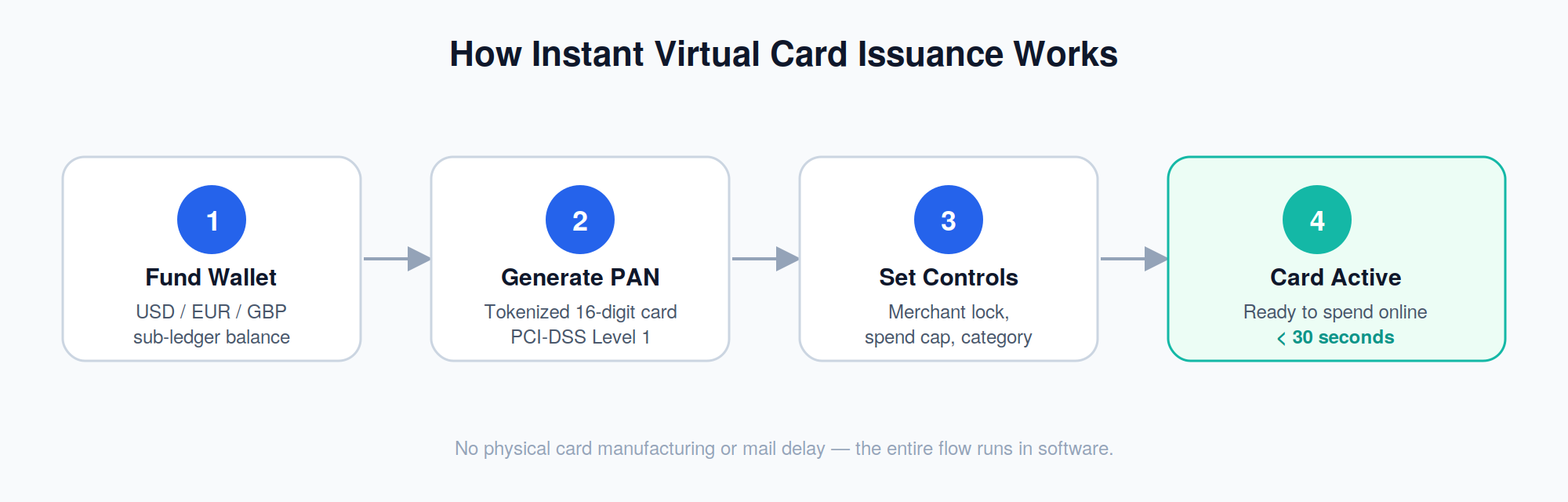
How it works: When you request a card, the issuer's platform generates a PAN (primary account number) via tokenized infrastructure, ring-fences funds from your balance, and activates the card for use typically in under 30 seconds. No physical plastic is manufactured or mailed.
Example: A SaaS founder needs a card for a $49/month analytics subscription. Instead of exposing a company Amex, they issue a single-merchant virtual card capped at $49, funded only for that charge.
Benefits:
Instant issuance no 5–7 day mail wait
Card-level spend caps and merchant locks
No exposure of a primary bank account number
Limitations:
Not usable for in-person tap/chip payments unless paired with a mobile wallet
Some legacy merchants still reject non-physical BINs
Actionable advice: Use single-merchant, capped cards for recurring subscriptions — it's the single easiest way to stop being billed after you meant to cancel.
Virtual Debit Cards vs. Credit Cards vs. Prepaid Cards
Funding: A virtual debit card draws from a pre-funded wallet or linked bank account. A virtual credit card runs on a line of credit, meaning you're borrowing against a limit rather than spending funds you've already deposited. A prepaid card sits somewhere in between — you load a fixed balance onto it upfront and spend from that.
Issuance speed: Virtual debit cards are typically the fastest to get, often issued in seconds since there's no credit check involved. Virtual credit cards can take anywhere from a few minutes to several days, depending on how quickly the credit check clears. Prepaid cards usually take about a day to activate and load.
FX surcharge: If you're spending across currencies, virtual debit cards tend to be the cheapest option, with surcharges of 0–1% when issued on a multi-currency BIN. Virtual credit cards typically run 1–3%, while prepaid cards are usually the most expensive, often 3% or higher.
Ad platform acceptance: Both virtual debit and virtual credit cards see high acceptance rates on major ad platforms. Prepaid cards are hit-or-miss acceptance ranges from moderate to low, since some platforms flag them as higher-risk.
Spend limits: Virtual debit cards offer the most flexibility, letting you set fully custom limits per card. Virtual credit cards are bound by whatever credit limit has been assigned. Prepaid cards are the least flexible — your limit is simply whatever balance you loaded.
API support: Virtual debit cards generally have the strongest API support, making them easy to issue and manage programmatically at scale. Virtual credit cards have decent but less common API access. Prepaid cards rarely offer this at all.
Want me to swap this into the article file in place of (or alongside) the existing debit-vs-physical comparison?
2. Why Do Traditional Bank Cards Suffer High Decline Rates and Hidden FX Markups Cross-Border?
Definition: A cross-border decline happens when a card issuer's risk engine flags a transaction because the merchant's country, currency, or category doesn't match the cardholder's home banking profile.
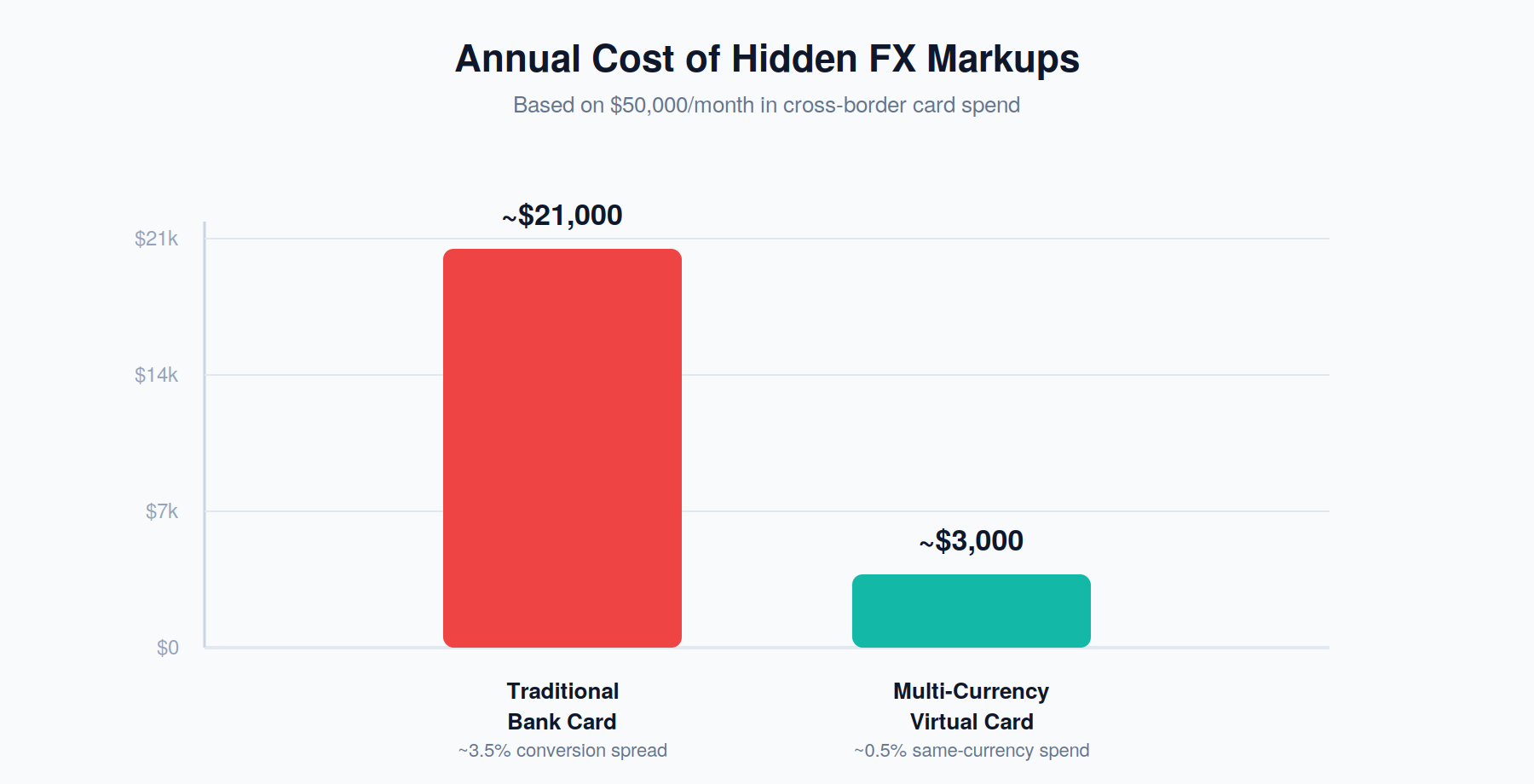
Explanation: Legacy bank debit cards are issued against a single home-currency account. When you spend abroad, the bank converts currency at its own rate commonly 2.5–3.5% above the interbank rate and its fraud model is tuned for domestic spending patterns, so foreign transactions get flagged more often.
Example: A business spending $50,000/month internationally on a single-currency bank card can lose roughly $1,500 $1,750 a month $18,000–$21,000 a year purely to conversion spread, before counting failed-transaction friction.
Benefits of multi-currency virtual cards here: Holding native USD, EUR, and GBP balances and spending from the matching currency card avoids the conversion step entirely for same-currency purchases.
Limitations: You still pay a spread when converting between currencies to fund a balance in the first place the savings come from avoiding repeated per-transaction conversion, not from eliminating FX altogether.
Actionable advice: Audit your last three months of statements for the currency conversion line item. If it's consistently over 1% of cross-border spend, a multi-currency card pays for itself immediately.
Common Decline Codes and What They Mean
Code 51 — Insufficient funds: This means there isn't enough balance on the card or wallet to cover the transaction. The fix is straightforward: top up the sub-ledger before retrying the payment.
Code 62 — Card restricted for this merchant category or region: This happens when the card's permissions don't match where or how it's being used. Check that the card's BIN and category settings actually align with the merchant you're trying to pay if they don't, the transaction will keep failing until they're adjusted.
Code 83 — 3DS authentication failed or timed out: This occurs when the one-time password (OTP) verification isn't completed in time, or the details entered don't match. To resolve it, complete the OTP within the session window and make sure the billing details entered match exactly what's on file, then retry.
3. How Do US & EU Multi-Currency BINs Reduce Cross-Border Fees and Improve Approval Rates?
Definition: A BIN (Bank Identification Number) is the first six-to-eight digits of a card number, identifying the issuing bank and country. Merchant risk engines check the BIN's country against your billing address and IP.
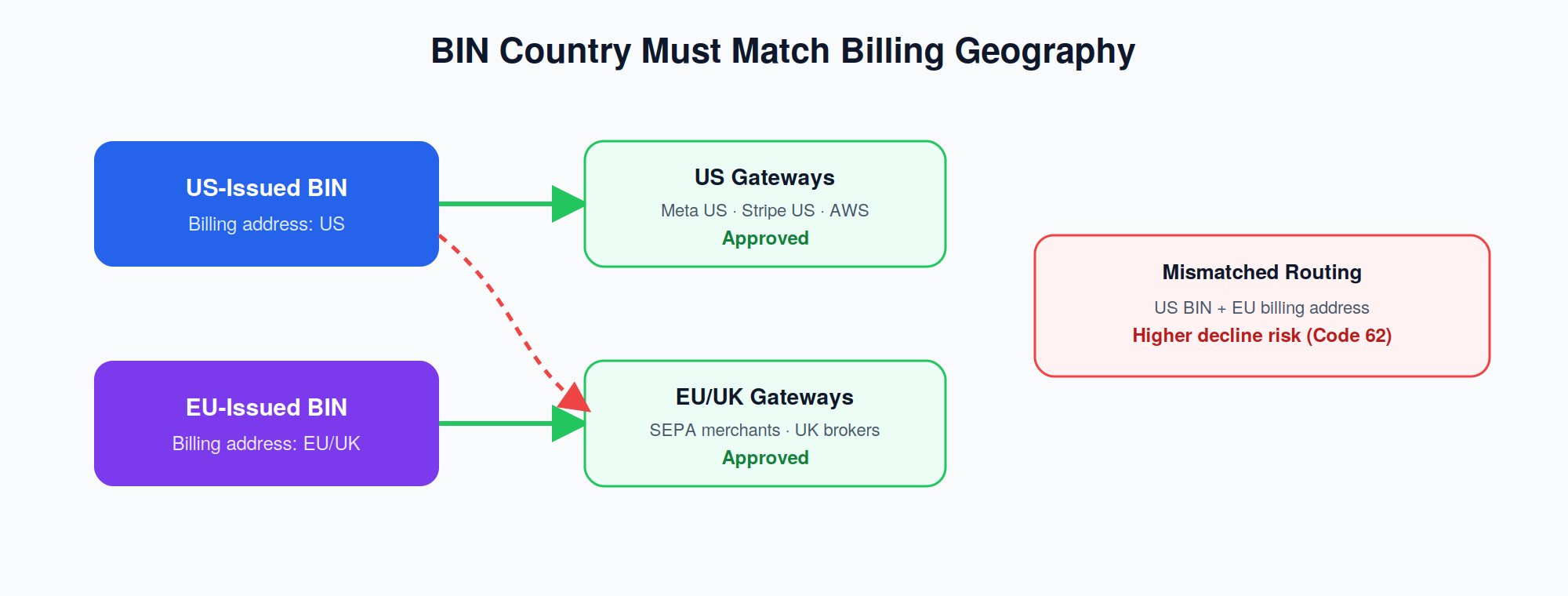
Explanation: The industry is transitioning from 6-digit to 8-digit IINs (ISO/IEC 7812) as card issuance volume grows, giving issuers more distinct BIN ranges per region. A US-issued BIN routes cleanly through US gateways; a European BIN routes through SEPA and UK processors with fewer friction checks.
Example: A US-based e-commerce operator advertising on a US ad platform should hold a US BIN card billed to a matching US address mismatches between BIN country and billing address are one of the more common reasons legitimate transactions get held for review.
Benefits: Matching BIN geography to where you actually operate reduces false-positive fraud flags and speeds up approval.
Limitations: Multi-currency BIN access varies by provider not every issuer offers true local BINs in every region, so confirm coverage before committing spend.
Actionable advice: If you operate in both the US and EU, keep separate cards funded in the matching local currency rather than one card billing everything in a single home currency.
4. What Are the Top Use Cases for Virtual Debit Cards?
Definition: Virtual cards solve distinct problems depending on the vertical speed of funding, spend isolation, or programmatic issuance.
Forex & Crypto Traders
Traders need to fund broker margin accounts quickly. A virtual card avoids the 1–3 business day hold that ACH or wire transfers often carry, letting a deposit clear in time to act on a market move.
High-Risk and Regulated Merchants
Businesses operating in categories like iGaming (MCC 7995) or brokerage services (MCC 6211) often get their payment processing disrupted with little warning when a single processor decides the category is too risky. Spreading transaction volume across properly disclosed, category-appropriate cards with a provider that explicitly supports those MCCs reduces the odds of a sudden, business-wide payment outage. This is about processing stability for a legitimately operating, licensed business — not concealing the merchant category from the card issuer, who should always know what you're using the card for.
Agencies and Teams Managing Multiple Budgets
Marketing agencies running spend for several clients benefit from issuing a separate card per client account, each capped to that client's budget and tagged for reconciliation. This keeps client billing cleanly separated and auditable each card should be tied to a real, disclosed business relationship, not used to disguise who's actually behind an account to a platform's terms-of-service enforcement.
Programmatic REST API & Webhooks for Developers
Definition: An API-driven card platform lets a business issue, fund, freeze, or cancel cards programmatically rather than through a dashboard.
Example: An expense management SaaS can call an issuance endpoint the moment an employee's expense request is approved, generating a capped card automatically and firing a webhook back to its own ledger when the transaction settles.
Benefits: Removes manual card-request bottlenecks; syncs natively with accounting software. Limitations: Requires engineering resources to integrate and monitor webhook reliability. Actionable advice: Start with sandbox/test-mode issuance before wiring live funding into any automated workflow.
5. How Does 3DS v2.2 and Authentication Streaming Secure Virtual Card Payments?
Definition: 3D Secure 2.2 is the current EMVCo authentication standard requiring Strong Customer Authentication (SCA) under PSD2 for most European transactions, using risk-based, low-friction challenges instead of static passwords.
Explanation: Because a virtual card has no physical owner present, providers stream the one-time password (OTP) directly to the account dashboard in real time, so the cardholder can complete verification during checkout without a text message to a physical phone.
Example: A remote team member in a different country from the card's registered number can still complete 3DS verification by reading the OTP from the dashboard rather than waiting on SMS delivery, which is often delayed or blocked internationally.
Benefits: Faster checkout completion; fewer failed authentications from SMS delivery issues abroad. Limitations: Merchants using older 3DS 1.0 flows may not support streamed OTP delivery gracefully.
Merchant Refunds to a Frozen or Deleted Card
Refunds don't disappear if a card is frozen or deleted the card number is a tokenized alias over your wallet, not the actual store of funds. Reputable issuers route the refund back to the underlying wallet balance automatically, even after the card itself is gone. Confirm this explicitly with any provider before relying on it, since implementation varies.
Actionable advice: Before canceling a card you've used for a purchase, check the provider's stated refund-routing policy rather than assuming.
6. Top 5 Mistakes Businesses Make Choosing a Virtual Card Platform
Using consumer-app cards for business spend — many retail apps cap monthly volume around $10,000, which businesses hit fast.
Ignoring the top-up spread — some providers charge 1–2% just to load a balance, quietly eating the FX savings you were chasing.
Running all spend through one card — a single card flagged by one gateway can disrupt every merchant relationship tied to it.
Depending on a single-BIN issuer — no BIN diversity means no fallback if that specific range gets deprioritized by a payment network.
Skipping the compliance check — not confirming the provider's licensing before moving meaningful volume through it.
Actionable advice: Treat card platform selection like vendor due diligence, not a signup form — check licensing, BIN diversity, and fee schedule before funding.
7. How to Generate a Virtual Debit Card on Qeam.net
Register and complete streamlined KYB (Know Your Business) verification.
Fund your account in USD, EUR, or GBP.
Select a BIN and set spend caps — merchant lock, monthly limit, or single-use.
Issue the card — typically active in under 30 seconds.
Actionable advice: Set the spend cap before the first transaction, not after — it's the control that actually prevents billing surprises.
8. How Does Qeam.net Compare to Revolut, Wise, and Privacy.com?
Target market: Qeam.net is built for business and enterprise use. Revolut and Wise both serve a mix of consumer and business customers. Privacy.com focuses specifically on US consumers.
BIN diversity: Qeam.net offers multi-region coverage across the US and EU, giving businesses more flexibility for international spend. Revolut and Wise both offer more limited BIN diversity by comparison. Privacy.com is US-only, so it isn't built for cross-border card issuance.
Custom spend caps: All four providers support per-card spend limits, so this is one area where they're evenly matched Qeam.net, Revolut, Wise, and Privacy.com each let you set custom caps on individual cards.
API and webhook support: Qeam.net and Privacy.com both offer available API and webhook access, making them easier to integrate into existing finance or engineering workflows. Wise offers more limited API support. Revolut restricts full API access to its business tier, so it's not available across all account types.
Multi-currency sub-ledgers: Qeam.net, Revolut, and Wise all support multi-currency sub-ledgers, useful for businesses managing spend across regions. Privacy.com is the outlier here — it only supports USD, with no multi-currency sub-ledger option.
Want this dropped into the article as a new section, and should I place it near the business-adoption section or closer to the FAQ?
Actionable advice: If your primary need is US-only subscription control, Privacy.com is simpler. If you need genuine multi-currency BIN routing and disclosed support for regulated categories, that's where a platform like Qeam.net differentiates.
9. Regulatory Compliance and Banking Security Framework
Definition: Client fund protection depends on the issuer's licensing and how it holds your money — not just its app's features.
Explanation: In the US, compliant issuers register as Money Services Businesses (MSBs) with FinCEN. In Europe, providers operate under PSD2 through licensed banking partners, with client funds held in ring-fenced accounts separate from the company's own operating capital — meaning the funds aren't part of the issuer's balance sheet if the company runs into financial trouble.
Actionable advice: Before funding a large balance, ask directly: which bank actually holds the underlying funds, and is it ring-fenced from the issuer's own accounts?
10. Frequently Asked Questions
Can I get a virtual debit card online instantly without waiting for physical mail? Yes. Reputable providers issue and activate a usable card number within seconds to a minute of funding, with no physical card required.
Do virtual debit cards eliminate cross-border transaction fees? They significantly reduce them by matching your spending currency to the card's currency, avoiding per-transaction conversion — but funding a balance in a foreign currency still involves an initial conversion spread.
Are virtual debit cards accepted on major ad platforms and forex brokers? Generally yes, provided the card's BIN country matches the account's registered billing details and the merchant category is disclosed accurately to the issuer.
What happens to my money if a merchant refunds a card that's been frozen? With most compliant issuers, the refund routes back to your underlying wallet balance, since the card number is a token layered over that balance rather than the funds themselves.
Is there an API for programmatic virtual card issuance? Yes providers with developer support offer REST APIs and webhooks to issue, fund, and freeze cards automatically from your own systems.
What's the difference between a virtual credit card and a virtual debit card? A virtual debit card draws from funds you've already loaded; a virtual credit card draws against a credit line and requires underwriting.
11. Conclusion: Choosing Your Virtual Card Infrastructure
A virtual debit card online isn't just a convenience feature for any business spending across currencies or managing many small vendor relationships, it's a meaningful cost and control lever. The decision comes down to three questions: does the provider offer real multi-currency BIN coverage, is your fund protection backed by a licensed, ring-fenced banking partner, and does the fee schedule actually deliver the FX savings on paper?
Start small issue one capped card for a single recurring expense, confirm the funding, spend cap, and refund Behaviour work as described, then scale up from there.