TL;DR
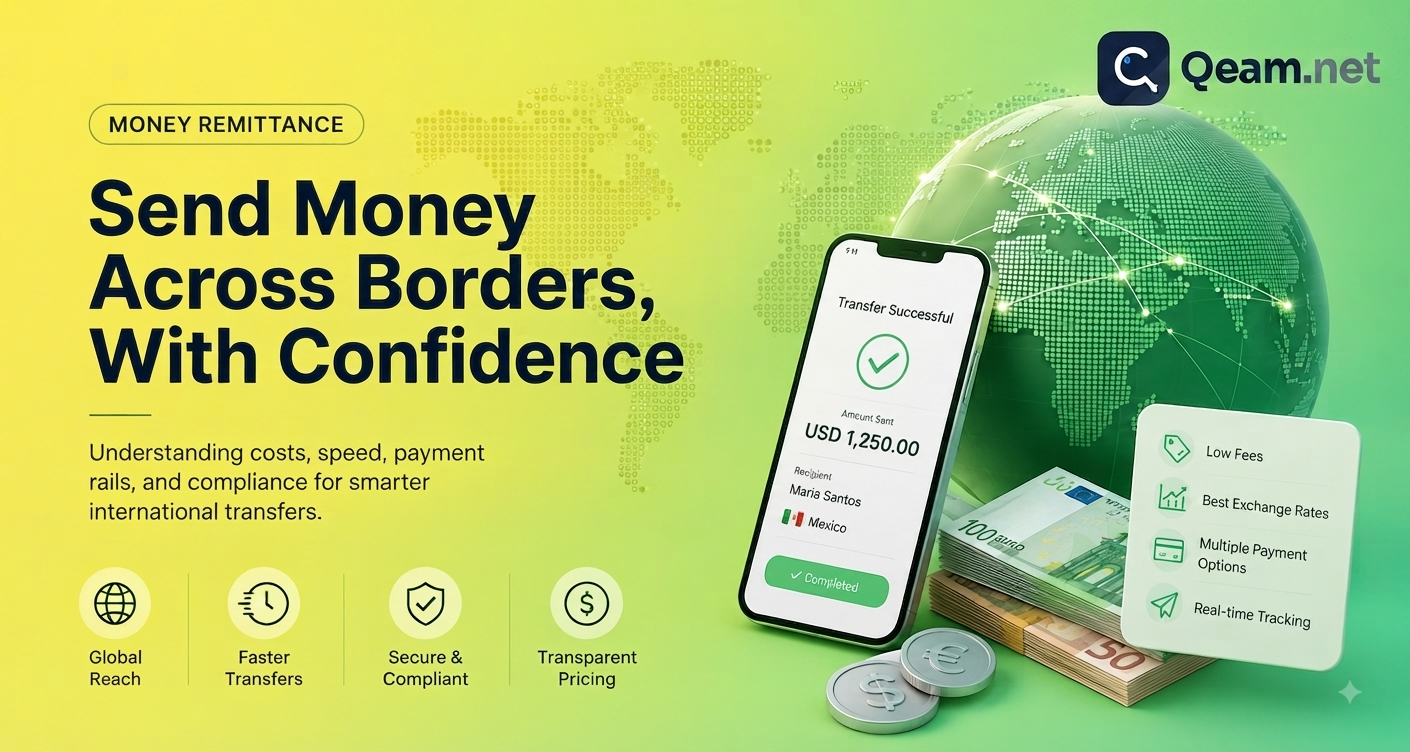
Money remittance is the transfer of money from one person or business to another, usually across countries. A remittance can move through a bank, money transfer operator, fintech app, payment platform, or digital payment rail. The final cost and delivery time depend on the currency pair, payment method, exchange rate, transfer route, destination country, and compliance checks.
For consumers, the most important comparison is not the advertised transfer fee. It is the total amount the recipient receives after the transfer fee, foreign exchange spread, and any intermediary or receiving bank charges.
For businesses, remittance is increasingly part of payment infrastructure. Marketplaces, payroll providers, fintech platforms, and global employers can use APIs, multi currency accounts, local payment rails, and automated compliance workflows to send international payouts at scale.
This guide explains how money remittance works, how much it costs, how long it takes, what compliance checks can delay a transfer, how to track or recall a payment, and how businesses can build cross border payout infrastructure.
What Is Money Remittance?
Money remittance is the sending of money from a sender to a recipient, typically across a domestic or international border. International remittances commonly involve currency conversion and may pass through banks, money transfer operators, correspondent institutions, payment processors, or local payment networks before reaching the recipient.
A typical international remittance has five stages:
Funding: The sender pays using a bank account, card, cash, wallet, or another supported method.
Compliance: The provider checks identity, transaction information, sanctions exposure, and, where required, source of funds.
Currency conversion: The provider converts the sender's currency into the recipient's currency when the currencies differ.
Settlement: Funds move through the provider's banking, correspondent, or payment rail relationships.
Payout: The recipient receives the funds in a bank account, wallet, cash pickup location, or another supported destination.
The important distinction is that the customer facing app is not necessarily the network that settles the money. A fintech may provide the interface while relying on banks, payment institutions, local clearing systems, or prefunded accounts underneath.
That distinction explains why two providers can offer the same apparent service but deliver different speeds, exchange rates, fees, and reliability.
What determines the cost of a remittance?
The total cost normally comes from four components:
Total remittance cost = transfer fee + FX spread + intermediary charges + receiving side charges
The exchange rate matters because a provider can advertise a low or zero transfer fee while earning revenue through the exchange rate offered to the customer.
The World Bank reported that the global average cost of sending $200 was 6.4% in Q4 2023, still substantially above the UN Sustainable Development Goal target of 3%.
What determines how fast a remittance arrives?
Delivery time depends on the payment rail, destination country, operating hours, compliance screening, currency conversion, intermediary institutions, and whether the provider can pay out directly through a local rail.
A transfer using a domestic real time payment system at the destination may settle much faster than one that requires several correspondent banks.
The fastest route is therefore not automatically the cheapest route, and the cheapest route is not automatically the safest route.
How Does International Money Remittance Work?
SWIFT, UETR, and Local Payment Rails
SWIFT is primarily a financial messaging network. It allows financial institutions to exchange standardized payment instructions, but it does not itself hold customer funds or perform the final settlement.
For many cross border payments, the transaction can involve several institutions before the recipient is credited. Depending on the corridor, the payment may use correspondent banking relationships, domestic clearing systems, or local payment rails for the final stage.
SWIFT gpi improves visibility into this process. A UETR, or Unique End to End Transaction Reference, acts as a standardized tracking reference for eligible SWIFT payment messages and allows participating institutions to identify and track the payment through the payment chain.
A UETR should therefore be understood as a payment tracking reference, not a guarantee of instant settlement.
Why Local Rails Matter
The final delivery stage can be handled through domestic payment infrastructure. Examples include India's UPI, Brazil's Pix, and other domestic account to account payment systems.
This creates an important distinction:
International messaging and domestic payout are not necessarily the same thing.
A provider may receive funds internationally and then use a local account or payment rail to deliver the recipient's money. That model can reduce dependence on a correspondent bank for every individual payout, although the provider still needs appropriate liquidity, banking relationships, compliance controls, and settlement arrangements.
ISO 20022 and Better Payment Data
ISO 20022 provides a richer structured data framework for financial messages. More structured information can improve payment processing, reconciliation, screening, and exception handling because institutions can receive more standardized transaction and party information.
However, ISO 20022 does not eliminate compliance reviews or guarantee faster settlement. Its main advantage is better structured payment information and interoperability, not automatic instant payments.
Remittance Compliance: AML, KYC, and Reporting Rules
International money transfers can trigger identity verification, transaction monitoring, sanctions screening, source of funds checks, and regulatory reporting. The exact requirements depend on the countries involved, the provider, the transaction type, and the circumstances.
AML and KYC Checks
KYC, or Know Your Customer, is the process a financial institution or regulated payment provider uses to verify a customer's identity.
AML, or Anti Money Laundering, refers to controls designed to detect and prevent the movement of illicit funds.
A provider may request additional information when a transfer is unusual for the customer, involves higher risk factors, contains inconsistent information, or requires additional verification under its compliance program.
There is no single global remittance threshold that automatically determines whether a customer must complete enhanced KYC. Providers and regulators apply different requirements depending on jurisdiction and risk.
For US money services businesses, FinCEN requires certain MSBs, including money transmitters, to file suspicious activity reports when the applicable conditions are met.
Source of Funds Checks
A provider may ask for documents showing where funds came from, such as:
Salary or employment records
Bank statements
Property sale documents
Tax documentation
Business invoices
Investment or inheritance records
A compliance request does not automatically indicate suspected criminal activity. It can be part of ordinary transaction monitoring and risk based controls.
FBAR Is Not a Remittance Tax
FBAR is a separate US reporting requirement concerning certain foreign financial accounts.
A US person generally must file an FBAR when the aggregate value of qualifying foreign financial accounts exceeds $10,000 at any point during the calendar year. Simply sending money to a foreign bank account does not by itself create an FBAR filing requirement.
Tax Treatment Depends on the Jurisdiction
A remittance is not automatically taxable simply because money crosses a border. Tax treatment depends on what the payment represents and the laws that apply to the sender and recipient.
A family support payment, salary, business payment, gift, inheritance, investment transfer, and property transaction can have very different tax consequences.
For large or unusual transfers, readers should confirm the applicable rules with the relevant tax authority or a qualified tax professional rather than relying on a universal remittance threshold.
What Does FATF Grey List Status Mean for Remittances?
A country being placed under FATF increased monitoring, commonly called the "grey list," means that the jurisdiction is working with FATF to address identified strategic weaknesses in its AML and counter terrorist financing framework.
Grey list status does not automatically mean that every transfer to or from the country is prohibited, high risk, or subject to enhanced due diligence. FATF explicitly states that its standards do not envisage automatic de risking or cutting off entire classes of customers.
In practice, an individual provider may still apply its own risk based controls based on the customer, transaction, corridor, counterparties, sanctions exposure, and other factors.
The practical lesson for senders is simple:
Do not treat FATF list status as a universal transfer rule. Check the provider's current corridor availability and documentation requirements before sending.
Example: How a Global Payroll Platform Should Design Remittance Infrastructure
Consider a platform paying 500 contractors across 12 countries each month.
The infrastructure problem is not simply "how to send 500 payments." It is how to manage 12 currencies, multiple payout methods, identity checks, transaction monitoring, reconciliation, FX conversion, payment failures, and local settlement rules without creating 500 separate manual workflows.
A scalable architecture can separate the process into five layers:
Customer and beneficiary data — identity, account details, tax information, and payout preferences.
Compliance layer — KYC, AML screening, sanctions screening, transaction monitoring, and applicable regulatory controls.
Treasury layer — currency balances, FX conversion, liquidity, and funding.
Payment orchestration — routing each payout through the most appropriate bank or local payment rail.
Reconciliation layer — matching payment instructions, settlement confirmations, fees, FX, and exceptions.
This produces an important Information Gain point:
At scale, the primary remittance problem shifts from moving money to controlling the entire payment lifecycle.
That is why APIs, automated reconciliation, local payout connectivity, and compliance orchestration become strategically important for marketplaces, payroll platforms, fintechs, and other businesses making recurring international payments.
Frequently Asked Questions
What is money remittance?
Money remittance is the transfer of money from one person or business to another, usually across a domestic or international border. International remittances can involve currency conversion, banks, money transfer operators, payment processors, correspondent institutions, and local payment rails.
How long does an international remittance take?
Delivery can range from near real time to several business days. The actual time depends on the payment method, destination country, currencies involved, compliance checks, operating hours, intermediary institutions, and the receiving payment rail.
Why is my remittance pending?
A remittance can remain pending because of identity verification, sanctions screening, incorrect beneficiary information, missing payment data, source of funds checks, intermediary processing, or a technical exception. The provider's transaction reference is usually the fastest way to identify the specific cause.
Can an international remittance be recalled?
A sender can generally request a recall after initiating a transfer, but a recall is not guaranteed. The outcome depends on whether the payment has already settled, the receiving institution, the payment rail, and the provider's procedures. Requesting a recall as early as possible generally gives the sender more options.
What is a UETR?
A UETR, or Unique End to End Transaction Reference, is a standardized 36 character reference used in SWIFT payment messages. It allows participating institutions and tracking services to identify and follow a payment through the payment chain.
Is remittance taxable?
Not automatically. Tax treatment depends on what the payment represents and the tax laws applying to the sender and recipient. Family support, salary, business payments, gifts, inheritance, and investment transfers can be treated differently.
Is a FATF grey listed country banned from receiving remittances?
No. FATF increased monitoring does not automatically prohibit remittances to or from a jurisdiction. Providers may apply their own risk based controls, so corridor availability and documentation requirements should be checked with the specific provider.
Sources and Editorial Methodology
This guide separates general payment infrastructure concepts from jurisdiction specific regulatory requirements.
Market and remittance cost statistics should be checked against current World Bank data. Regulatory explanations should be verified against the applicable regulator or standard setting body, including FATF, FinCEN, and the IRS for US related requirements.
Payment infrastructure terminology is based on industry standards and documentation covering SWIFT payment messaging, UETR tracking, ISO 20022, correspondent banking, and local payment systems.
Because remittance regulations, provider policies, exchange rates, corridor availability, and tax rules can change, readers should verify current requirements before making a large or unusual transfer.
This article is educational and does not constitute legal, tax, financial, or regulatory advice.
From Money Transfers to Remittance Infrastructure
For an individual sending money internationally once a month, remittance is primarily a question of cost, speed, exchange rate, and reliability.
For a business sending thousands of payments, the problem changes.
A marketplace may need to pay sellers in multiple countries. A payroll platform may need to pay contractors in different currencies. A fintech may need to offer cross border transfers without building separate banking and payment integrations for every market.
At that point, remittance becomes infrastructure rather than a single transaction.
A modern remittance infrastructure stack typically needs:
Multi currency accounts and balances
International payment connectivity
Local payout rails
FX conversion
KYC and KYB workflows
Sanctions and transaction monitoring
Payment status and webhooks
Automated reconciliation
Treasury and liquidity management
API based payment orchestration
This is the foundation of Remittance as a Service (RaaS): financial infrastructure that allows a platform to offer cross border transfers under its own customer experience instead of building every banking, FX, compliance, and payment connection independently.
For businesses, the strategic question is therefore no longer simply "How can we send money internationally?"
It becomes:
"How can we make international money movement a reliable, compliant, programmable part of our product?"
Conclusion
Money remittance is no longer simply a transaction between a sender and a recipient. Modern cross border payments depend on a combination of payment rails, FX, liquidity, compliance, account infrastructure, settlement, and reconciliation.
For individuals, the right choice usually comes down to the total cost, delivery speed, exchange rate, reliability, and requirements of the destination corridor.
For businesses, the challenge is larger. Marketplaces, fintechs, payroll platforms, SaaS companies, and global businesses need infrastructure that can move money across borders while managing currencies, beneficiaries, compliance checks, payment status, and reconciliation at scale.
That is where API based financial infrastructure becomes important. Instead of building separate banking and payment connections for every market, businesses can integrate the capabilities they need into their own products and workflows.
Qeam.net brings these capabilities together across IBAN accounts, international payments, FX, global payouts, Banking as a Service, and Remittance as a Service, giving businesses a foundation for building and operating cross border financial flows.
The future of remittance is not simply about moving money faster.
It is about making global money movement programmable, transparent, compliant, and scalable.