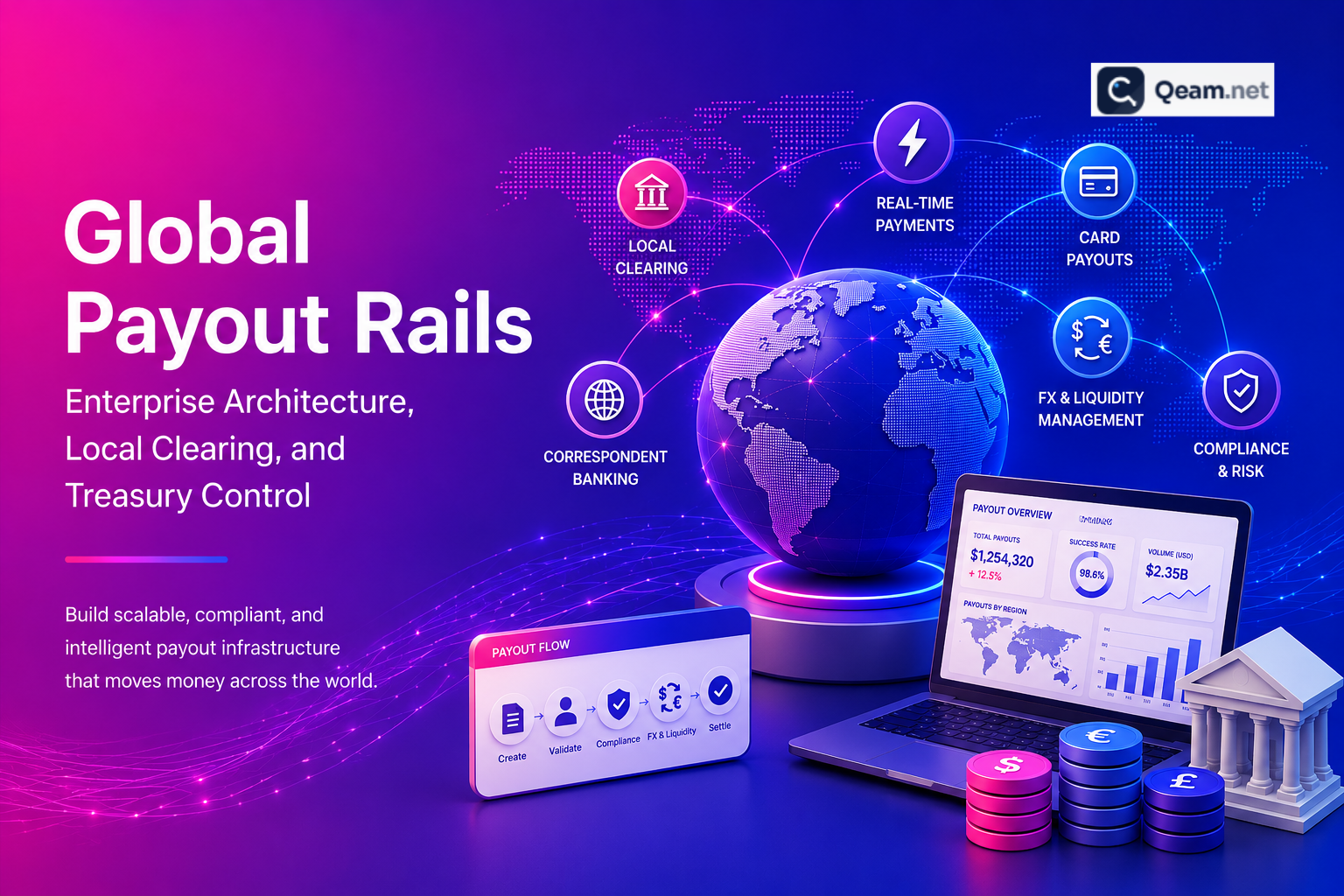
Global payout rails are the payment infrastructure, domestic clearing networks, banking connections, FX systems, liquidity arrangements, ledger controls, compliance processes, and APIs used to send funds across countries and currencies.
For enterprises, fintechs, marketplaces, payroll providers, SaaS companies, and cross-border businesses, global payouts involve much more than sending an international bank transfer. A scalable payout system must determine which rail should process each transaction, whether liquidity needs to be pre-funded, how FX exposure is controlled, how balances are recorded, and how failed transactions are recovered and reconciled.
Modern payout infrastructure can combine correspondent banking, domestic payment schemes, real-time payment networks, card payout networks, local banking partners, and API orchestration. This allows businesses to route transactions according to country, currency, beneficiary type, transaction value, urgency, cost, compliance status, liquidity, and rail availability.
This guide explains how global payout rails work, how enterprises manage multi-currency payouts, and what businesses should consider when evaluating global payout infrastructure.
What Are Global Payout Rails?
Global payout rails are payment networks and processing routes used to send money to beneficiaries in different countries and currencies.
A complete payout operation includes beneficiary validation, compliance screening, FX conversion, ledger posting, liquidity management, payment routing, settlement monitoring, reconciliation, and reporting.
The basic workflow is:
Payout instruction → beneficiary validation → compliance checks → FX and liquidity checks → ledger reservation → rail selection → payment submission → settlement → reconciliation.
The payment rail is therefore only one component of the overall architecture.
Main Types of Global Payout Rails
Correspondent banking supports international transfers where payments may pass through intermediary financial institutions before reaching the beneficiary bank. It remains important for international corridors where suitable domestic alternatives are unavailable.
Domestic payment rails connect participants within a country's banking or payment infrastructure and are commonly used for payroll, marketplace, supplier, and recurring business payouts.
Real-time payment networks support faster domestic transfers. Examples include FedNow in the United States, PIX in Brazil, UPI in India, and SEPA Instant in Europe.
Batch payment networks process transactions according to defined clearing cycles. ACH is a major example in the United States. Nacha reported that the ACH Network processed 35.2 billion payments worth $93 trillion during 2025. Nacha ACH information
Card push networks provide another payout method where the beneficiary's eligible debit or prepaid card can receive funds.
Hybrid payout orchestration combines multiple rails behind one API, allowing the platform to select an appropriate payment route based on transaction requirements.
Enterprise Global Payout Architecture
A reliable payout architecture normally contains several connected layers.
The orchestration layer receives payout instructions and selects the appropriate processing route.
The beneficiary layer stores and validates recipient information.
The compliance layer applies applicable KYC, KYB, sanctions, AML, fraud, and transaction-monitoring controls.
The FX layer manages currency conversion, rates, markups, quote expiry, and exposure.
The ledger layer records balances, reservations, fees, FX adjustments, settlements, returns, and reversals.
The treasury layer manages liquidity across currencies, entities, and settlement accounts.
The connectivity layer connects banks, payment providers, and payment schemes.
The event layer manages asynchronous status updates and webhooks.
The reconciliation layer matches internal transactions with provider, bank, and scheme records.
Correspondent Banking vs Local Clearing
Correspondent banking can provide international reach but may introduce intermediary institutions, additional fees, FX costs, and more complex investigations.
Local clearing can provide a more direct route when appropriate domestic infrastructure and banking access are available.
However, local clearing is not automatically better for every transaction. The correct route depends on country, currency, beneficiary reach, payment value, liquidity, compliance requirements, settlement rules, and provider coverage.
Intelligent Payout Routing
A routing engine can evaluate:
Country and currency
Beneficiary type
Transaction value
Required delivery speed
Rail availability
Transaction limits
Total payment cost
FX cost
Liquidity availability
Compliance status
Cut-off times
Holidays and maintenance windows
Routing should also include fallback and exception rules. A failed rail should not automatically trigger another payment without checking whether the alternative route is permitted and whether the transaction remains valid.
Multi-Currency Ledger Architecture
A multi-currency ledger records financial balances and movements separately by currency while maintaining consistent accounting across the platform.
A robust ledger should support double-entry accounting and distinguish between available, reserved, pending, submitted, processing, settled, failed, returned, and reversed balances.
It should also record transaction, account, beneficiary, currency, legal entity, payment rail, provider reference, and reconciliation information.
Multi-Entity Ledger Management
Multi-entity businesses should not treat all balances as one unrestricted global pool.
Different entities may have different legal ownership, regulatory obligations, bank accounts, safeguarding requirements, and settlement exposure.
The ledger should distinguish economic ownership, legal ownership, operational custody, and intercompany movements.
This is particularly important for marketplaces, payroll platforms, and fintech groups operating through multiple subsidiaries.
Payout State Management
A practical state model can include:
created → pending_review → approved → funded → submitted → processing → settled
Exception states can include:
failed, returned, cancelled, expired, reversed, and unknown.
The unknown state is essential when a platform loses connectivity after submitting a payment but before receiving a definitive response.
The transaction should be reconciled before another payment is created. Blindly retrying with a new transaction identifier can result in duplicate payouts.
FX Management for Global Payouts
FX risk occurs when a payout is funded in one currency but delivered in another.
Exposure can arise between payout authorization, FX quotation, funding, submission, and settlement.
For example, a marketplace may approve EUR payouts while maintaining USD liquidity. If EUR strengthens before the platform purchases the required EUR liquidity, the USD cost of the payout batch can increase.
A production FX process should record the currency pair, exchange rate, quote ID, timestamp, markup, expiry period, and applicable tolerance.
The platform should also define what happens when an FX quote expires. Depending on the business model, the payout may be repriced, rejected, or processed under an approved treasury policy.
For larger payout volumes, treasury teams may manage FX exposure individually, at batch level, or through broader hedging policies.
Pre-Funding and Liquidity Management
Pre-funding means maintaining liquidity in a destination account or settlement arrangement before payouts are submitted.
It can improve settlement reliability but may create fragmented balances and idle capital across currencies.
Liquidity pooling coordinates balances across accounts, currencies, or entities to improve treasury efficiency.
Pooling can reduce unnecessary idle liquidity, but it does not automatically eliminate local funding requirements. Legal ownership, safeguarding arrangements, settlement cycles, regulatory restrictions, and banking structures still matter.
A hybrid approach can maintain local liquidity for high-volume or time-sensitive corridors while funding long-tail corridors closer to execution.
There is no universal amount that every platform should pre-fund. Treasury teams should forecast payout volumes by currency and settlement window and add buffers for peak demand, returns, holidays, FX volatility, provider limits, and operational incidents.
Global Payment Rails by Market
United States
The United States combines batch and instant payment infrastructure.
ACH supports a broad range of business and consumer payments, while FedNow provides participating financial institutions with an instant payment infrastructure designed for continuous operation. Federal Reserve FedNow Service
Enterprises should evaluate ACH, FedNow, RTP, wires, and other options according to beneficiary reach, transaction limits, operating rules, cost, liquidity, and required delivery speed.
United Kingdom
The UK supports payment methods including Faster Payments and Bacs.
Faster Payments is suited to faster domestic transfers, while Bacs supports batch-oriented use cases such as payroll and recurring business payments.
Payout systems should account for beneficiary validation, processing windows, bank participation, holidays, and payment type.
Eurozone and SEPA
SEPA Credit Transfer supports euro payments across the SEPA environment, while SEPA Instant enables faster euro transfers under the instant payment scheme framework. European Payments Council SEPA documentation
Important implementation considerations include IBAN validation, participant reach, applicable limits, compliance controls, and settlement requirements.
Brazil
PIX is Brazil's instant payment infrastructure. Banco Central do Brasil describes PIX as an instant payment solution available around the clock, including non-business days. Banco Central do Brasil PIX information
Payout systems should consider beneficiary identifiers, fraud controls, participant access, limits, and regulatory requirements.
India
UPI enables instant account-to-account payments through participating institutions under India's regulated payment ecosystem. NPCI UPI information
Businesses should evaluate beneficiary data, transaction limits, participating institutions, fraud controls, and applicable regulatory requirements.
Singapore
Singapore supports payment infrastructure including FAST and PayNow. Enterprises should evaluate participant coverage, beneficiary identifiers, transaction limits, settlement behavior, and compliance requirements.
UAE, Canada, Australia, and Switzerland
These markets require corridor-specific evaluation because payout availability depends on local banking infrastructure, currencies, beneficiary accounts, participating institutions, and applicable payment rules.
For any market, providers should verify country coverage, currency support, beneficiary eligibility, limits, fees, settlement timing, and last-verified information rather than making universal "global" or "instant" claims.
Settlement Times and Cut-Offs
A payment cut-off time is the latest point at which a payment instruction, funding event, compliance approval, or other required processing event can enter a particular settlement cycle.
Cut-offs vary by rail, currency, provider, bank, transaction type, time zone, and holiday calendar.
Payout platforms should model submission cut-offs, funding windows, compliance review periods, beneficiary bank acceptance, weekends, holidays, and exceptional processing conditions.
"Instant" should also be defined carefully. It can refer to API acceptance, rail submission, scheme settlement, or actual beneficiary funds availability. These events are not necessarily identical.
Global Payout API Architecture
A global payout API should be treated as an asynchronous financial workflow.
A typical flow is:
Validate the payout.
Validate the beneficiary.
Create an idempotent request.
Reserve funds.
Apply compliance and risk controls.
Confirm FX and liquidity.
Select the payment rail.
Submit the transaction.
Process asynchronous events.
Reconcile the transaction.
Settle, return, reverse, or investigate.
Idempotency
Every payout creation request should support a stable idempotency key.
If the client times out after submission, repeating the request with the same key should retrieve or return the original transaction rather than creating another payout.
Reusing the same key with materially different parameters should be rejected.
Webhook Failure Handling
Webhook delivery should be treated as an at-least-once event stream.
The receiving system should verify the signature, persist the event, deduplicate it by event ID, acknowledge it quickly, and process business logic asynchronously.
Failed deliveries should use bounded retry logic with exponential backoff and jitter. Providers should ideally support event replay or API reconciliation.
Unknown Transactions
A network timeout does not prove that a payment failed.
If the transaction may already have reached the provider, the platform should retrieve its status and reconcile the result before attempting another payment.
This is one of the most important safeguards against duplicate payouts.
Payout Compliance Architecture
Compliance should span onboarding, beneficiary management, payout creation, screening, routing, settlement, reconciliation, and audit.
Beneficiary verification should occur before payment submission.
Sanctions screening, AML monitoring, fraud prevention, tax operations, safeguarding, and data protection should be treated as separate control areas rather than one generic "compliance" function.
ISO 20022
ISO 20022 is a structured financial messaging standard used by various financial infrastructures.
An API provider may normalize customer data and map it into the message formats required by downstream payment systems.
"ISO 20022 compatible" should therefore be defined precisely by supported message types, fields, mappings, and payment rails.
FATF Travel Rule
The FATF Travel Rule concerns originator and beneficiary information requirements for relevant virtual asset transfers.
It should not be presented as a universal requirement for every fiat payout. Applicability depends on the transaction, entities involved, jurisdictions, and applicable legal framework. FATF virtual assets guidance
Tax and Audit Controls
Depending on the business model and jurisdiction, payout operations may require beneficiary tax classification, withholding, reporting, documentation, corrections, and record retention.
A global payout API should not imply that one system independently determines every international tax obligation.
Every important payment action should also have an auditable record covering the transaction, controls applied, FX decision, payment rail, external references, status events, and final accounting treatment.
Global Payout Use Cases
Marketplace Payouts
Marketplaces need seller-level balances, commissions, refunds, reserves, taxes, split settlements, and multi-currency payouts.
The payout system should connect seller balances with payment execution so each transaction can be traced from marketplace activity through final settlement.
Payroll Payouts
Payroll requires predictable value dates, employee and account validation, funding, local tax controls, confidentiality, holiday handling, and rapid exception resolution.
Instant payment infrastructure can improve delivery speed but does not replace payroll calculation or employment compliance.
SaaS, Creator, and Gig Economy Payouts
These businesses often require high-volume disbursements with beneficiary onboarding, payout thresholds, tax documentation, fees, fraud controls, refunds, and reconciliation.
"Instant payout" should always define whether it means API acceptance, payment processing, settlement, or beneficiary funds availability.
How to Choose a Global Payout Provider
Evaluate providers across several areas.
Geographic coverage: Verify actual countries, currencies, beneficiary types, and payment methods.
Rail coverage: Determine whether the provider supports domestic, instant, batch, cross-border, and card-based payment options required for your corridors.
API capabilities: Check idempotency, webhooks, status APIs, error handling, sandbox access, reconciliation APIs, authentication, and documentation.
Treasury and FX: Evaluate supported currencies, prefunding, liquidity, FX rates, markups, settlement, and funding options.
Compliance: Determine which KYC, KYB, sanctions, AML, fraud, and monitoring controls the provider operates and which remain the customer's responsibility.
Reliability: Evaluate rail outages, failed payments, returns, unknown states, webhook failures, reconciliation, incident response, and recovery procedures.
Total cost: Consider transaction fees, FX spread, intermediary charges, funding costs, failed transactions, manual reconciliation, and liquidity requirements rather than comparing only headline fees.
Global Payout Rails FAQ
What are global payout rails?
Global payout rails are payment networks and processing routes used to send money to beneficiaries across countries and currencies. They can include domestic clearing systems, instant payment networks, correspondent banking infrastructure, card networks, and local banking connections.
How do global payout APIs work?
A payout API validates the beneficiary, reserves funds, performs applicable compliance checks, manages FX and liquidity, selects a payment rail, submits the transaction, receives status events, and reconciles the final payment against the internal ledger.
Do multi-currency ledgers eliminate local prefunding?
No. Multi-currency ledgers improve balance visibility and treasury management, but local liquidity requirements depend on the provider, destination rail, currency, settlement model, banking structure, and regulatory requirements.
Can one API support batch and instant payouts?
Yes. A unified API can support different payout methods, but the underlying rails may have different limits, cut-offs, settlement rules, compliance requirements, and cancellation procedures.
What happens when a webhook fails?
The provider should retry the event using controlled backoff. The receiving system should verify the signature, persist the event, deduplicate it, and process it asynchronously. Open transactions should also be reconciled through the API.
How much liquidity must a platform pre-fund?
There is no universal amount. Required liquidity depends on payout volume, currencies, settlement windows, peak demand, returns, holidays, FX exposure, provider limits, and the platform's treasury policy.
Enterprise Global Payout Deployment Checklist
Before deploying global payout infrastructure, confirm that the platform can:
Route payouts by country, currency, beneficiary, urgency, cost, liquidity, and compliance status.
Maintain a multi-currency, multi-entity double-entry ledger.
Reserve and release funds correctly.
Manage FX quotes and exposure.
Forecast and monitor liquidity.
Model cut-offs and holidays.
Validate beneficiaries.
Apply appropriate compliance and fraud controls.
Use stable idempotency keys.
Safely recover from timeouts.
Verify and deduplicate webhooks.
Retry and replay failed events.
Reconcile bank, provider, scheme, and ledger records.
Distinguish settled, failed, returned, reversed, and unknown transactions.
Maintain appropriate audit records.
Document relevant ISO 20022 mappings.
Assess applicable Travel Rule requirements.
Clearly disclose corridor coverage, fees, limits, and settlement definitions.
Maintain incident response and disaster recovery procedures.
Final Takeaways
Global payout infrastructure is more than a collection of payment rails. It is an orchestration layer connecting payment networks, banking partners, FX, liquidity, ledgers, compliance systems, APIs, settlement, and reconciliation.
The strongest payout architecture selects the appropriate route for each transaction rather than forcing every payment through one network.
Multi-currency ledgers provide the accounting foundation. FX controls manage currency exposure. Liquidity management ensures transactions can be funded. API controls such as idempotency and webhook reconciliation prevent duplicate or unresolved payments. Compliance architecture ensures that beneficiary, sanctions, AML, fraud, tax, safeguarding, and audit requirements are properly addressed.
When evaluating a global payout provider, enterprises should therefore look beyond advertised speed and transaction fees.
The key questions are:
Which countries and currencies are actually supported?
Which payment rails are available?
How is liquidity managed?
How is FX exposure controlled?
How are failed and unknown payments handled?
How are transactions reconciled?
Which compliance responsibilities belong to the provider?
Can the architecture scale across currencies, entities, countries, and payment volumes?
A provider that can answer these questions clearly is offering more than a payment API. It is providing financial infrastructure for scalable, controlled, and auditable global disbursements.