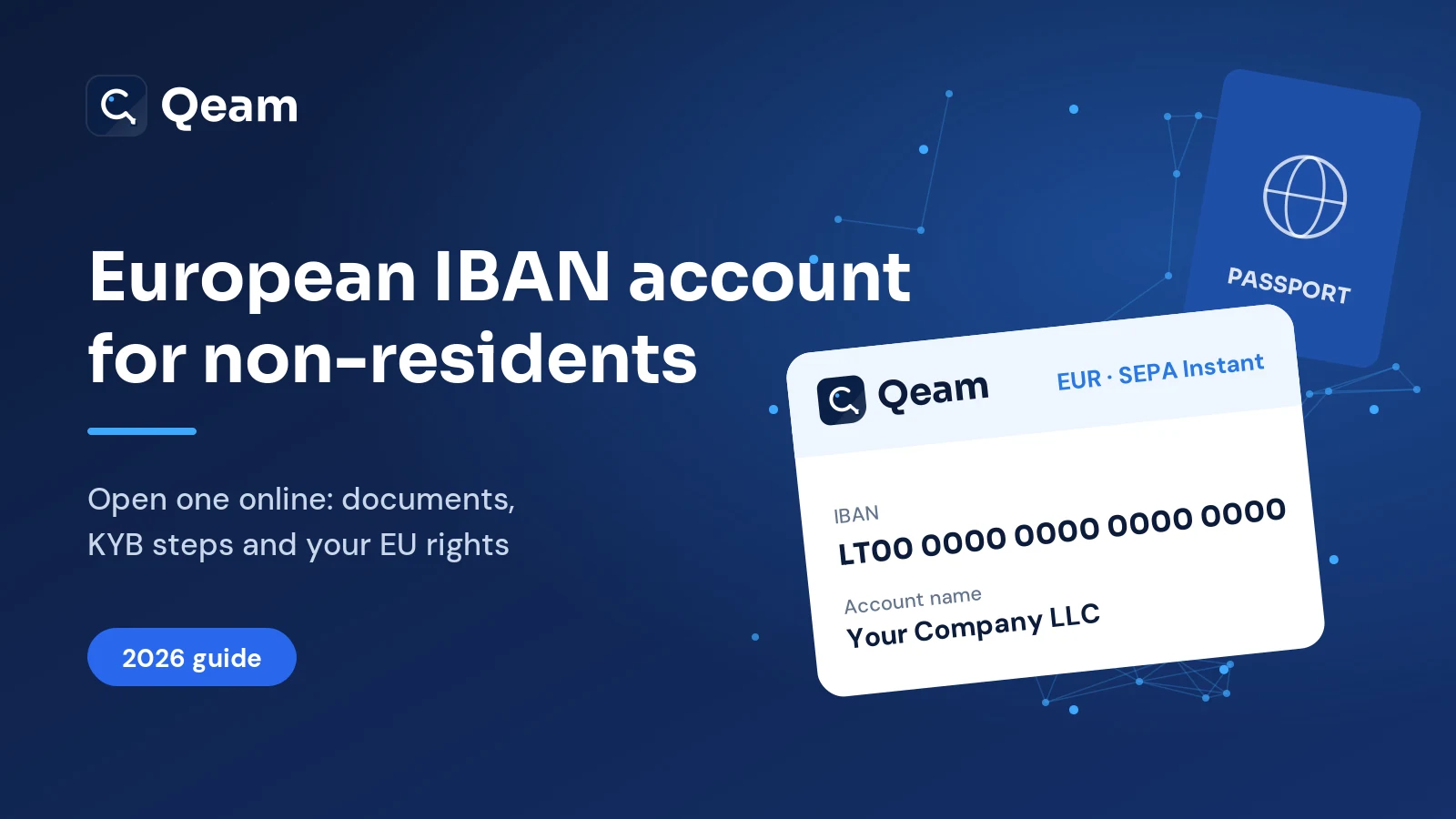
Can you open a European bank account online as a non-resident? Usually, yes. If you run a company in Delaware, Dubai or Pune and want European clients to pay you by SEPA, you can apply for a euro IBAN from your laptop. In most cases it comes from a licensed electronic money institution (EMI) rather than a high-street bank. Somebody will ask hard questions about your business, though, and a yes is never automatic.
Below: account types, paperwork, process, sticking points, and your legal protections.
Key takeaways
Non-residents can usually open a European IBAN online, most often through an EMI rather than a bank.
The EU right to a basic bank account only covers people legally resident in the EU. Companies and non-residents don't get it.
Businesses need a full KYB pack: company documents, owners, a clear business model and expected payment flows.
Pick a dedicated IBAN in your own name if clients will pay you by SEPA. Name checks now happen before transfers.
EMI funds are safeguarded, not covered by the €100,000 deposit guarantee. No provider can promise approval.
Can a non-resident open a European bank account?
In most cases, yes. The real question is which kind of institution will open it.
Traditional EU banks usually want a local tie: a residence address, a local tax number or a branch visit.
EMIs are a different animal. Each one holds a licence from an EU regulator, can issue IBANs, and was designed from day one to sign up customers it will never meet. The European Banking Authority set common rules for remote onboarding in its Guidelines on remote customer onboarding (EBA/GL/2022/15), which have applied since 2 October 2023.
The "basic bank account" right doesn't cover you
You may have read that everyone in the EU has a right to a bank account. Not quite. The Payment Accounts Directive gives that right to consumers legally resident in the Union, at credit institutions. A US LLC or a freelancer living in India can't rely on it, as the EU's own Your Europe guide confirms.
What is an IBAN, exactly?
An IBAN (International Bank Account Number) is a two-letter country code, two check digits, then a national account number of up to 30 characters, so 34 characters at most, with a fixed length for each country. SWIFT keeps the official IBAN registry under the ISO 13616 standard. An IBAN starting with LT is Lithuanian, and it works across SEPA.
Which account do you actually need?
"European bank account" covers four quite different products.
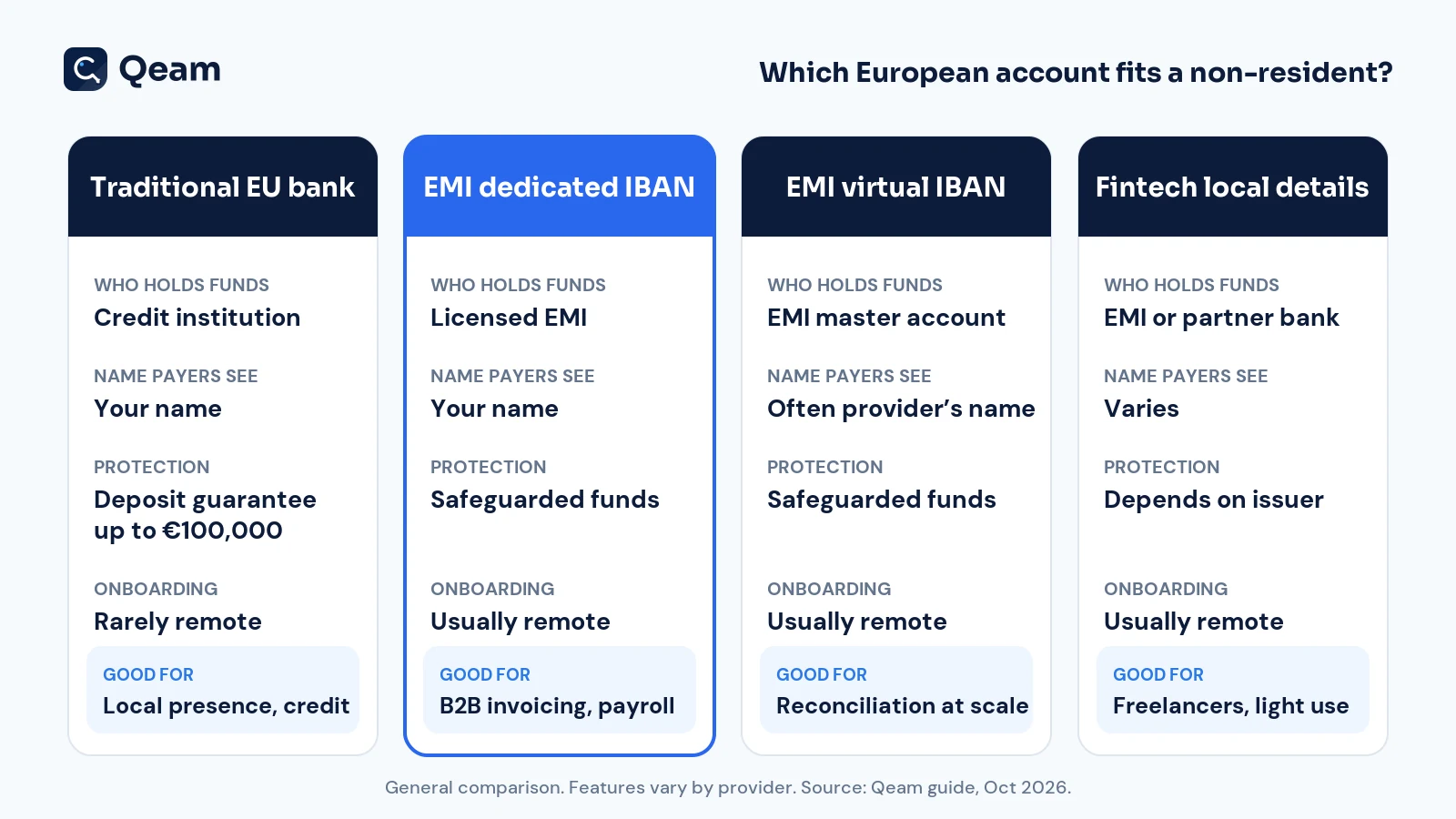
Traditional EU bank
Who holds your money: Credit institution
Name payers see: Yours
Protection: Deposit guarantee up to €100,000
Remote onboarding for non-residents: Rare
SEPA transfers: Yes
Good for: Local presence, credit
EMI, dedicated IBAN
Who holds your money: Licensed EMI
Name payers see: Yours
Protection: Safeguarding
Remote onboarding for non-residents: Common
SEPA transfers: Yes
Good for: B2B invoicing, payroll, suppliers
EMI, pooled or virtual IBAN
Who holds your money: Licensed EMI (master account)
Name payers see: Often the provider's or a master account's
Protection: Safeguarding
Remote onboarding for non-residents: Common
SEPA transfers: Yes
Good for: Marketplaces, reconciliation at scale
Fintech "local details"
Who holds your money: EMI or partner bank
Name payers see: Varies
Protection: Depends on the issuer
Remote onboarding for non-residents: Common
SEPA transfers: Yes
Good for: Freelancers, light use
Dedicated vs pooled IBAN: why the name now matters
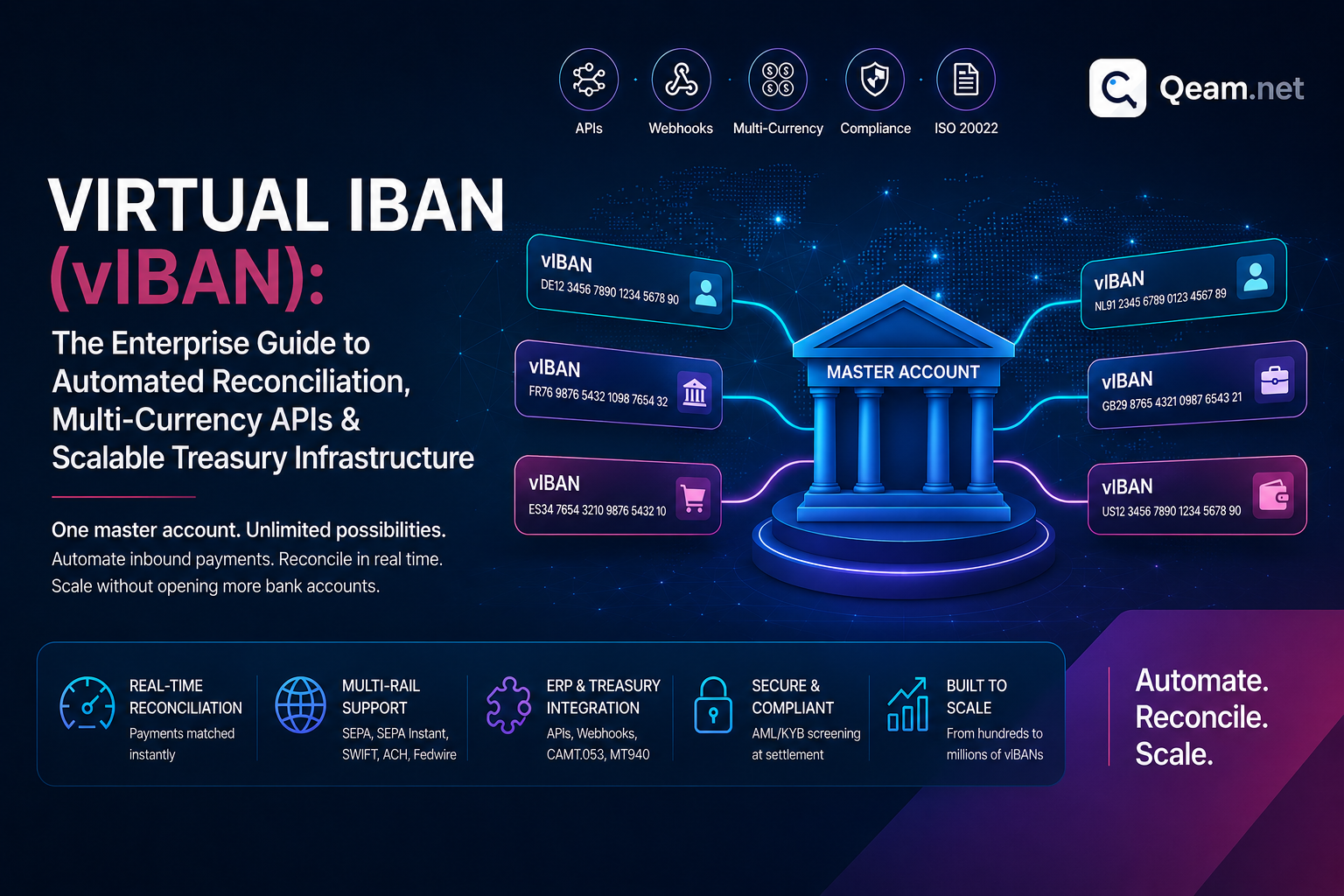
With a dedicated IBAN, the account is in your company's name. With a pooled or virtual IBAN, money lands in a master account and the provider routes it to you. Virtual IBANs are excellent for reconciliation (see our virtual IBAN guide), but there's a catch.
Since 9 October 2025, payment providers in euro-area countries must offer Verification of Payee under the Instant Payments Regulation. Before a customer approves a transfer, their provider checks that the name matches the IBAN, and the service must be free. Providers in EU countries outside the euro have until 9 July 2027. If your client types "Acme Trading LLC" and the account is registered under a provider's name, they may see a "no match" warning. For invoicing, a corporate IBAN in your own name avoids that friction.
Who is eligible, and who usually isn't?
Providers that onboard non-residents typically accept:
Companies registered outside the EU, such as a US LLC, a UK Ltd, a UAE free-zone company, an Indian private limited company or a Hong Kong Ltd
Sole traders and freelancers who invoice European clients
Individuals aged 18 or over with a valid passport
Applications get harder, or are refused, when:
The company or an owner is linked to a country on the FATF high-risk or monitored lists, or to sanctions
The business has no visible activity, website or customers
The ownership chain is unclear, for example through several holding companies
The industry is one the provider doesn't serve
Each provider sets its own risk appetite. Qeam.net, for instance, doesn't onboard clients from FATF grey- or black-listed jurisdictions or comprehensively sanctioned countries (see About & Compliance).
Documents you need to open a European IBAN account
Have these ready before you apply, as sharp, complete colour scans.
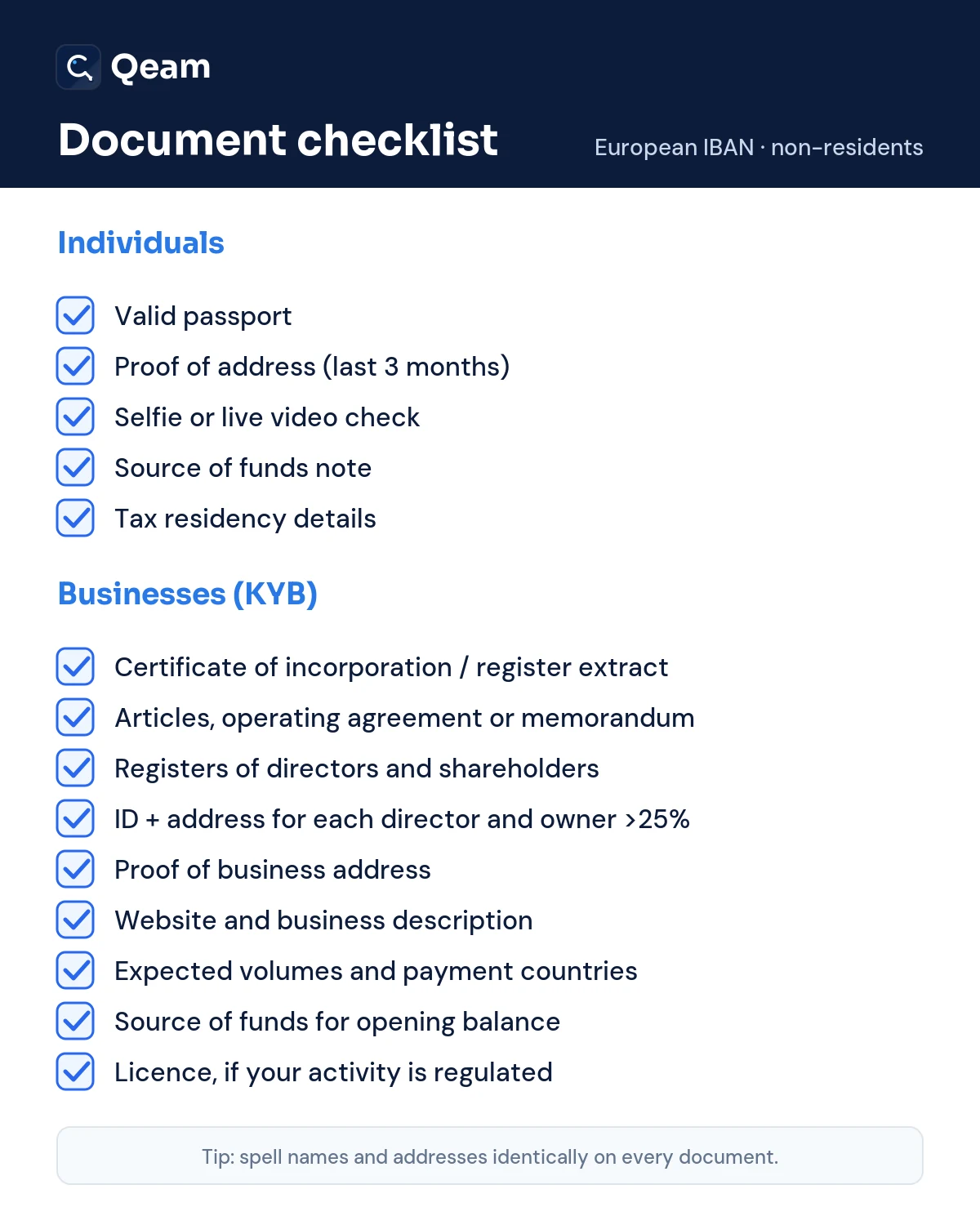
For individuals
Valid passport
Proof of home address dated within the last three months, such as a utility bill or bank statement
A selfie or live video check
A short note on where your money comes from (salary, client income, savings)
Your tax residency details
For businesses (KYB)
Certificate of incorporation or a current company register extract
Articles of association, operating agreement or memorandum
Register of directors and register of shareholders or members
Passport and proof of address for each director and beneficial owner
Proof of the business address
Website plus a plain description of what you sell and to whom
Expected monthly volumes and the countries you'll pay and get paid from
Source of funds for the opening balance
Any licence you hold, if your activity is regulated
A beneficial owner is usually anyone who owns more than 25% of the company, or who controls it some other way. That threshold comes from the EU's Anti-Money Laundering Directive. If your structure has layers, draw it. A one-page ownership chart often saves a week of back-and-forth.
Spell names and addresses identically everywhere, get certified English translations where needed, and explain in two lines why you need euros: "we invoice 14 clients in Germany and the Netherlands" beats "international business".
How to open a European IBAN account online, step by step
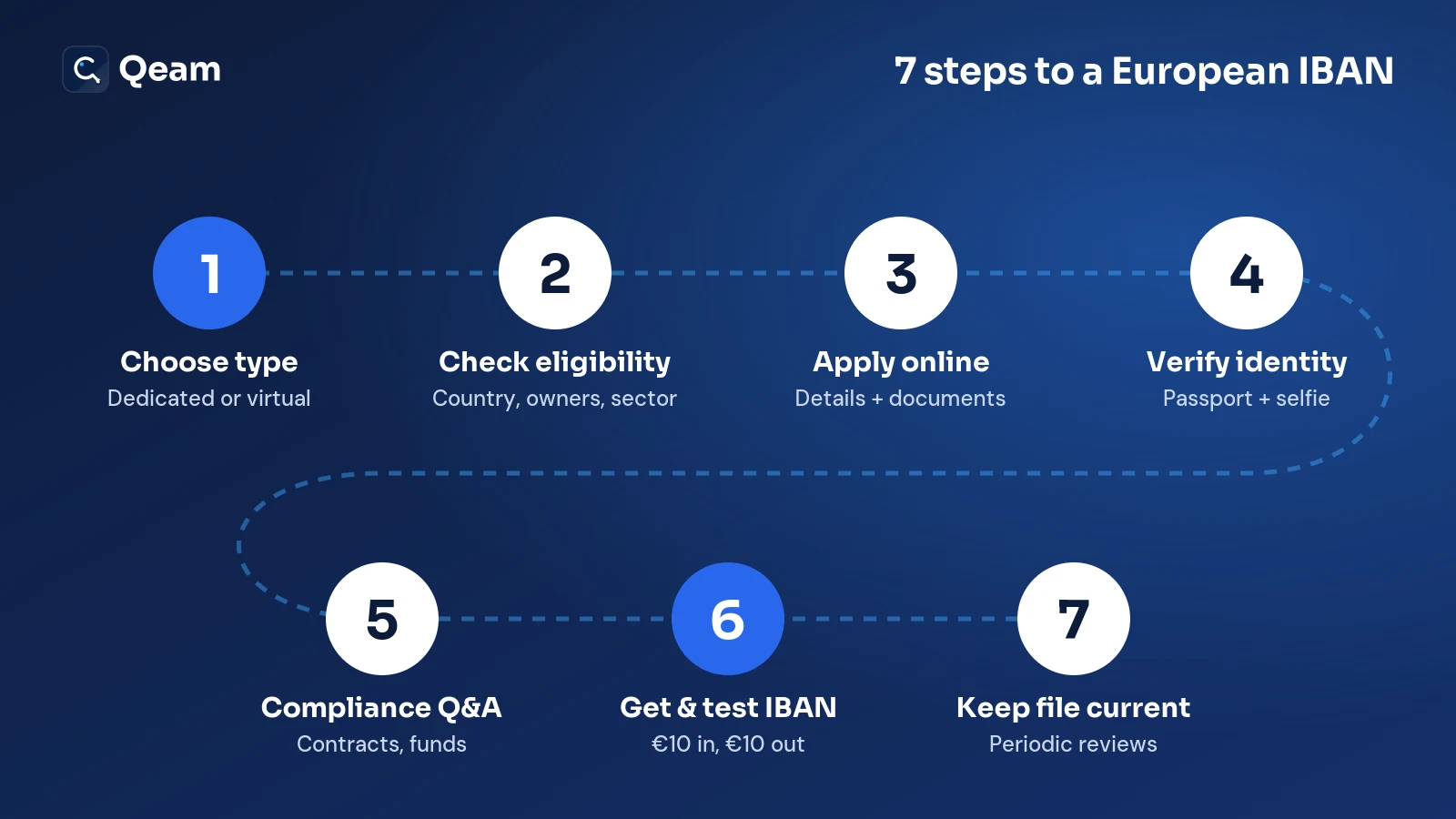
Choose the account type. Go back to the table. Sending invoices to German or Dutch companies? You want a dedicated IBAN in your company's name.
Check eligibility first. Ask whether the provider takes your country of incorporation, your owners' nationalities and your industry. It's a five-minute email that can save you a month.
Apply online. Company details, personal details, uploads.
Verify identity. Every director and beneficial owner scans a passport and does a selfie or short video.
Answer compliance questions. A reviewer may ask for a sample contract, two invoices, or where the opening balance came from.
Receive your IBAN and test it. Send €10 in and €10 out before the IBAN goes on your invoices.
Keep your file current. Providers re-check accounts from time to time. A new shareholder or a sudden spike in volume will usually prompt questions.
So how long? Honestly, it depends. One owner, one company, a live website and tidy documents can move within days. Put a Cayman holding company between you and the operating business and it can stretch to weeks. If a provider promises instant approval to everyone, ask yourself what checks they're skipping.
Why applications get delayed or rejected
Most problems trace back to a handful of gaps.
A vague business model. "Consulting" tells a reviewer nothing. "We build Shopify stores for EU retailers, average invoice €3,500" tells them almost everything.
Flows that don't match the story. You sell software to French clients, yet you forecast big inflows from countries you never mentioned. List your real corridors and explain anything odd.
A missing link in the ownership chain. Papers for the operating company arrive, but not for the holding company above it. Send every layer, right up to the humans.
Details that don't line up. The passport says one address, the utility bill another. A one-line note or a newer bill fixes it.
High-risk exposure. Owners, clients or suppliers in heavily sanctioned or FATF-listed countries. Say so upfront; a reviewer who finds it later trusts nothing else in the file.
A sector the provider won't touch. Some EMIs don't serve certain industries at all. Ask first.
[Qeam onboarding team: add 2–3 anonymised real patterns and a short quote from the reviewer here. Do not publish until supplied or removed.]
What does a European IBAN account cost?
There's no single price. Costs usually come from a mix of:
A monthly or annual account fee, which is often higher for non-EU or higher-risk profiles
Charges for SEPA transfers and for SWIFT payments outside SEPA
Currency conversion margins when you change euros into other currencies
Card fees, if you add a card
What about a "free EU IBAN account" for a non-resident business? Free tiers exist. But checking a company in another continent costs the provider real staff time, and that cost lands somewhere: per-transfer fees, a wider FX spread, tight limits. Take your expected month (say 40 incoming SEPA payments and two conversions to USD) and price that, not the headline. One rule works in your favour: under the Instant Payments Regulation, an instant euro transfer can't cost more than a standard one at the same provider.
Your rights once you have an EU IBAN
No one can reject your IBAN because of its country
Picture this. Your new IBAN starts with LT, and a French customer's finance team says they can only pay French accounts. They're wrong. Article 9 of the SEPA Regulation (EU) 260/2012 says a payer or payee "shall not specify the Member State in which that payment account is to be located", as long as the account can be reached through SEPA. The European Commission calls this IBAN discrimination. It asks people to report cases to the national competent authority.
Safeguarding is not deposit insurance
EU deposit guarantee schemes cover up to €100,000 per depositor, under the Deposit Guarantee Schemes Directive. That protection applies to deposits at credit institutions, i.e. banks.
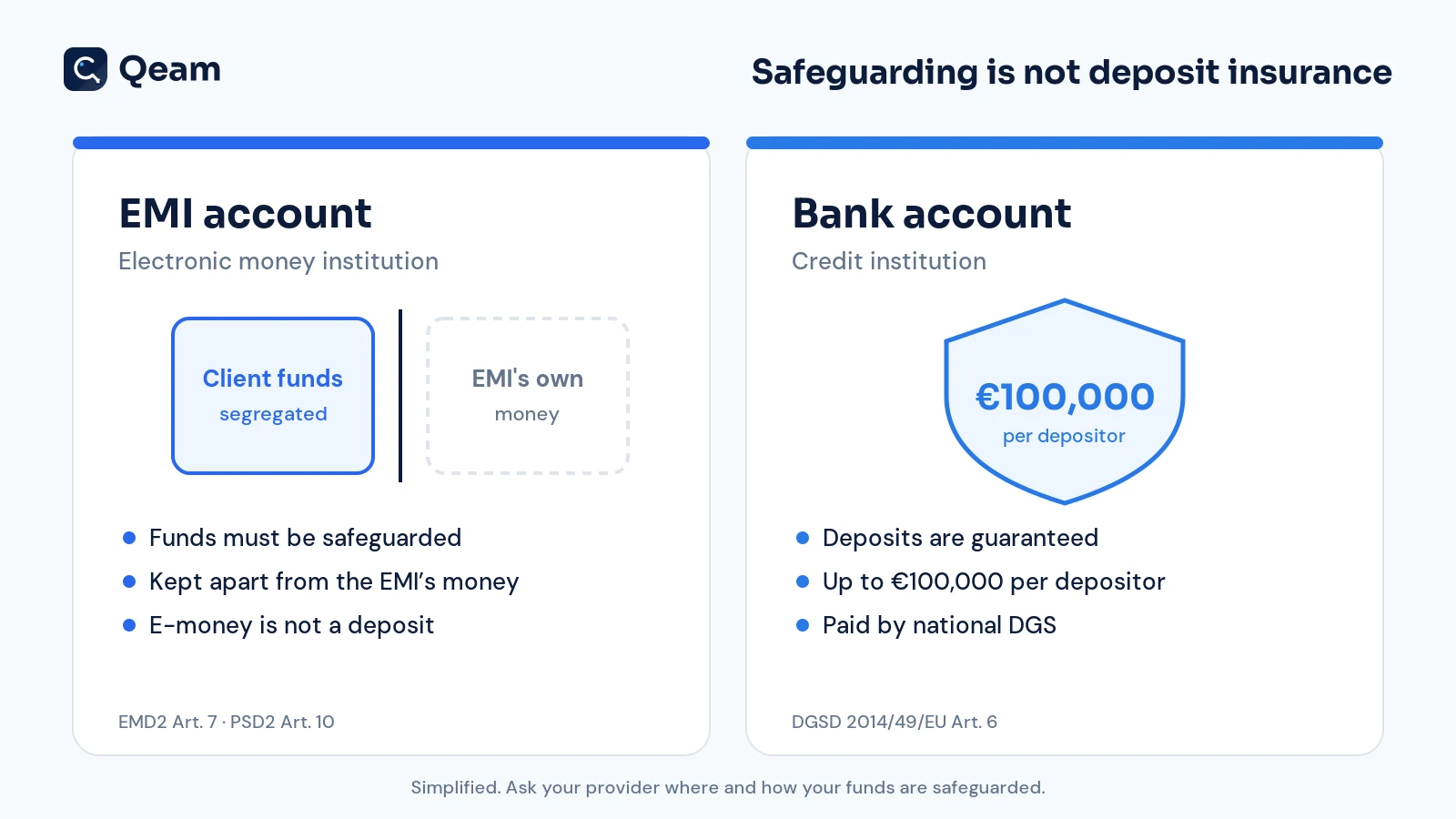
EMIs are not allowed to take deposits. Instead, the E-Money Directive requires them to safeguard customer funds. Under the PSD2 rules it points to, those funds must be kept separate from the firm's own money, for example in a segregated account at a bank. The aim is that customer money is ringfenced if the EMI fails. It's genuine protection, but it works differently, so ask any provider where your funds are safeguarded.
How Qeam.net helps non-EU businesses get a European IBAN
Qeam.net is a technology platform, not a bank or an EMI. EUR IBAN accounts are issued by our regulated EMI and banking partners in the European Economic Area. Those partners also safeguard client funds. Qeam.net doesn't hold them.
Through that partner network, businesses and individuals from more than 150 countries can apply for EUR IBAN accounts with SEPA and SEPA Instant. Applications from non-EU clients go through enhanced due diligence. Approval is at the partner's discretion and isn't guaranteed. You can see partner and safeguarding details on our regulatory disclosures page. The platform also offers virtual IBANs, cards, payouts and an API with a sandbox. See all services, or compare a corporate IBAN with an individual IBAN account.
FAQs
Can a US LLC open a European IBAN account?
Usually, yes. Many electronic money institutions accept US LLCs if the owners and directors pass identity checks and the business has real activity. Expect to provide formation documents, the operating agreement, details of each owner above 25% and a description of your European clients.
Do I need to live in the EU to get an EU IBAN?
No. EU residence isn't a legal requirement for an EMI account. It matters for the statutory basic bank account, which covers only consumers legally resident in the EU.
Can I open a European bank account online without visiting a branch?
Yes, with most EMIs and some digital banks, where identity is checked by video or selfie and documents are uploaded online. EU guidelines on remote onboarding have applied since October 2023.
How long does it take to get a European IBAN as a non-resident?
It ranges from a few business days to several weeks. You control two big factors: documents that match each other, and a business description a stranger can understand. Layered ownership and higher-risk sectors add time.
Is an EMI account as safe as a bank account?
It's protected differently: bank deposits are covered by the deposit guarantee up to €100,000. EMI funds aren't deposits. They must be safeguarded, which means kept separate from the EMI's own money.
Will EU customers accept an IBAN from Lithuania or another EU country?
They should. The SEPA Regulation bars payers and payees from demanding an account in a particular EU country, provided yours is reachable via SEPA. Refusals can be reported to the national competent authority.
What's the difference between a dedicated IBAN and a virtual IBAN?
A dedicated IBAN is an account in your own name. A virtual IBAN routes payments into a master account, which is handy for matching payments to customers but can trigger name-check warnings for your payers.
Is there a free European IBAN account for non-residents?
Some basic tiers have no monthly fee. Check transfer fees, FX margins and limits too, then price a typical month for your business.
The bottom line
Work out what the account is for before you compare providers. For most non-EU businesses invoicing European companies, a dedicated IBAN in your own name with SEPA Instant is the practical choice. Get the documents in order, answer questions quickly, and treat the checks as part of the deal.
How this guide was made: drafted with AI assistance, checked against the EU legal texts linked above, and reviewed by [Compliance reviewer name – Qeam to supply]. This article is general information, not legal or financial advice.