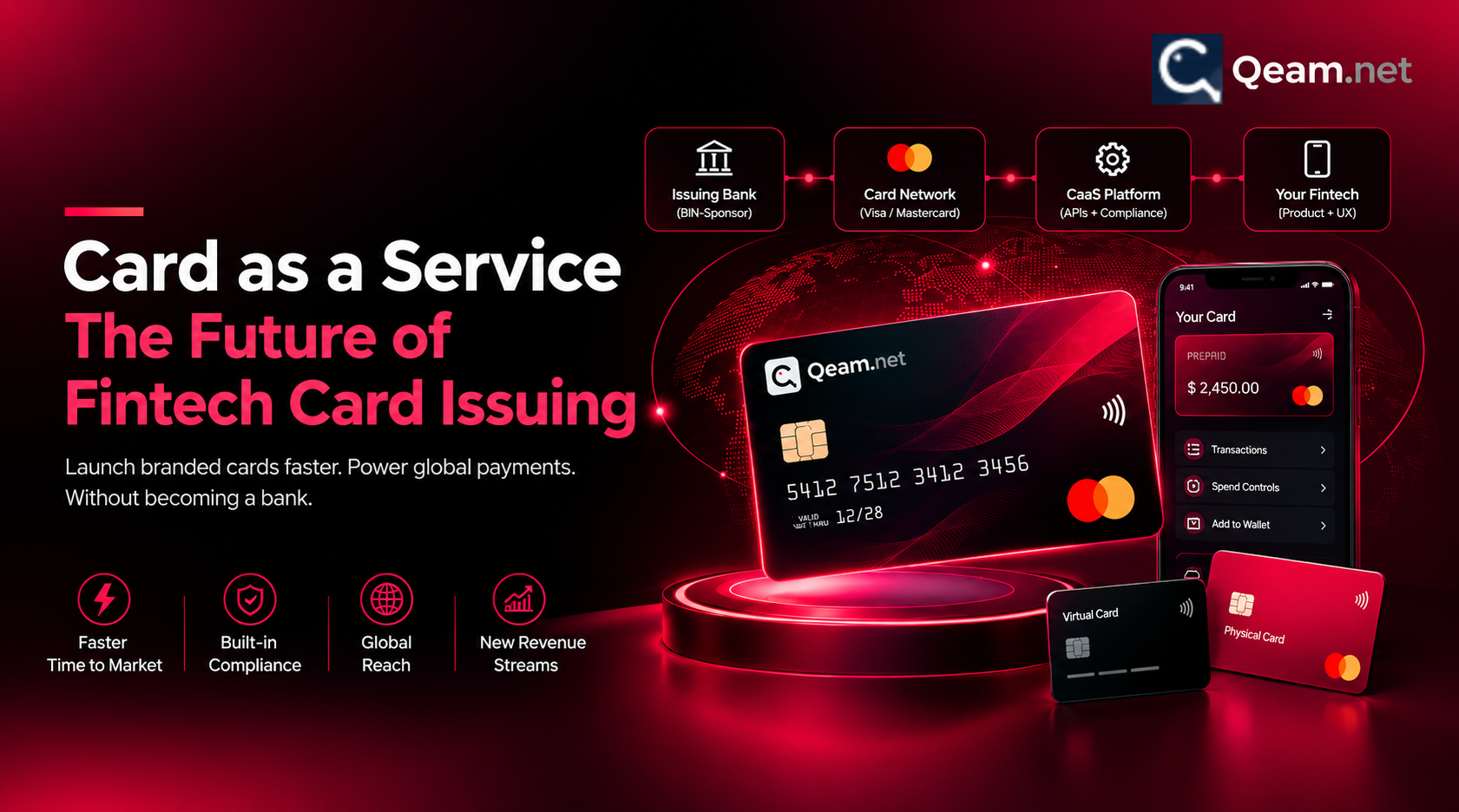
TL;DR: Card-as-a-Service lets any company issue branded virtual or physical payment cards through an API, without holding a banking license or negotiating directly with Visa or Mastercard. A CaaS provider supplies the BIN sponsorship, compliance layer, and card network relationship; you supply the product and user experience. Done right, it cuts time-to-market from over a year to a few months. Done carelessly - especially with a single issuer - it creates the exact dependency risk it was supposed to remove.
What is Card-as-a-Service (CaaS)?
CaaS is a model where a licensed financial infrastructure provider issues payment cards- virtual or physical -on behalf of a non-bank company, exposing the process through an API. The client (a neobank, marketplace, or trading app) never holds a banking license or direct network membership; the provider holds those relationships while the client controls branding, spend rules, and the app experience.
Example: A freight-payments startup wants a fuel card with per-load budgets. Instead of applying for a bank charter, it integrates a CaaS API, sets Merchant Category Code (MCC) controls, and has virtual cards live in drivers' wallets within weeks.
Benefits: no license required, faster launch, programmable spend controls from day one. Limitations: you're still dependent on the sponsor bank for compliance decisions, and margins are shared with issuer and network. Advice: before evaluating vendors, define currency, card type, and target geography in one sentence — it filters half the shortlist immediately.
How Card-as-a-Service Works Behind the Scenes
The architecture chains four parties — the licensed issuing bank, the BIN sponsor, the card network (Visa or Mastercard), and the program manager (the CaaS platform) — coordinated through APIs so the client integrates with one endpoint. When a cardholder taps to pay: the app calls the API, the card is issued under the sponsor bank's Bank Identification Number, the merchant routes an authorization request through the network, spend rules and fraud checks apply jointly, funds settle between acquirer and issuer, and the ledger updates instantly via webhook.
Example: A gig-economy app pays a driver instantly and lets them spend from a virtual card seconds later — the whole chain completes in under a second.
Benefits: real-time authorization and instant provisioning match bank-level speed without owning any rails. Limitations: every step is a dependency — if a sponsor bank pauses onboarding for regulatory review, as has happened industry-wide in recent years, every program on that BIN feels it at once. Advice: ask any provider for their sponsor bank's name and how many programs share the BIN. A refusal to answer is itself the answer.
Core Capabilities of Modern CaaS Platforms
Instant virtual card issuing generates a number, expiry, and CVV in software with no manufacturing step. An expense platform can issue a new hire a capped virtual card the moment onboarding is submitted. Limitation: virtual-only programs don't serve in-person, contactless retail cases, so default to virtual-first for B2B and reserve physical cards for consumer card-present spending.
Real-time spend controls and MCC restrictions filter transactions by category, velocity, or geography before authorization completes — a travel card can block every MCC outside travel and dining automatically. Risk: over-aggressive blocking causes false declines; launch permissive and tighten based on real transaction data.
Native mobile wallet tokenization replaces the real card number with a device-specific token in Apple Pay or Google Pay, so the actual number never reaches the merchant. It's now a baseline expectation, but push provisioning — adding a card from inside the fintech's own app — needs separate certification with Apple and Google, so confirm it's included before signing.
The Strategic Advantages for Fintechs
Accelerated time-to-market: direct bank partnerships typically take 12–18 months; CaaS providers commonly launch qualified programs in 8–12 weeks, since the infrastructure is pre-built. Earlier launch means earlier unit-economics data and earlier renegotiating leverage — though heavily customized products still take longer even on CaaS rails, so separate your MVP scope from your roadmap during vendor evaluation.
New revenue through interchange: CaaS programs typically pass a negotiated share of interchange fees back to the client, turning card spend from a cost center into a margin line. Rates vary sharply by region — EU caps are far lower than unregulated US commercial rates — so model revenue by region before committing to one global provider.
Overcoming Legacy Limitations: Why Multi-Issuer Architecture Matters
Multi-issuer architecture routes card programs across more than one sponsor bank or BIN, instead of depending on a single issuing relationship. Single-issuer dependency is the risk most CaaS marketing glosses over: if the only sponsor bank exits card programs or faces a regulatory consent order, every card under its BIN can be affected, sometimes with a mandated pause on new issuance. This isn't hypothetical — sponsor-bank enforcement actions have disrupted multiple fintech programs in recent years regardless of the fintech's own compliance record.
A multi-issuer setup distributes that risk, extends reach into regions a single issuer can't license, and gives programs somewhere to reroute if one issuer freezes — at the cost of extra integration overhead most early-stage fintechs don't yet have the volume to justify. Treat it as a milestone, not a launch requirement: plan for a second issuer once volume or a second jurisdiction makes it worthwhile, and pick a provider whose API stays issuer-agnostic enough to add one later.
Regulatory Compliance and Risk Management (KYC/AML)
CaaS removes the need for a license, not the compliance responsibility. KYC onboarding, AML transaction monitoring, and — in Europe — PSD2's strong customer authentication are typically shared between the CaaS platform and sponsor bank, with the client still on the hook for how it collects and presents customer data.
Working with an established provider means inheriting frameworks already through regulatory review — but responsibility is contractual, not eliminated. Regulators can and do hold the fintech accountable for KYC failures even when a partner bank handles licensing; "the bank handles compliance" is a common, costly misreading. Get the hand-off documented explicitly — who owns KYC decisioning, who owns monitoring, who's liable in an inquiry. Ambiguity here is the most common source of post-launch disputes.
Frequently Asked Questions About CaaS
Do I need a banking license to use Card-as-a-Service? No — providers operate under their own license and BIN sponsorship, letting you issue cards under your own brand.
What's the difference between BaaS and CaaS? Banking-as-a-Service is the broader category covering accounts, payments, and lending as well as cards; CaaS is the narrower subset focused on card issuance and network connectivity.
Physical vs. virtual card issuing APIs? Virtual cards are generated instantly and can go straight into a mobile wallet; physical cards need manufacturing and shipping, adding days to weeks.
How do companies make money from CaaS? Mainly a negotiated share of interchange fees, plus sometimes issuance fees and FX margins on cross-border spend.
Who are the top CaaS providers? The market splits between global players with broad network reach and regional specialists with deeper local licensing — fit depends on target geography and card type.
Traditional Card Issuing vs. API-Driven CaaS
The two paths differ mainly on speed and control. A direct bank partnership typically takes 12–18 months and requires the fintech to build much of its own compliance infrastructure alongside the bank's, through custom, manually negotiated contracts — workable for large institutions with an existing banking relationship that want bespoke control. API-driven CaaS compresses that to roughly 8–12 weeks by letting the fintech operate under the provider's existing license and BIN sponsorship, integrating through APIs and SDKs instead. The trade-off is switching cost later: an embedded direct-bank relationship is hard to unwind, while a CaaS setup stays easier to migrate if kept issuer-agnostic. For most startups prioritizing speed over bespoke control, CaaS is the more practical starting point.
Common Mistakes to Avoid
Treating the sponsor bank as invisible — it's the biggest risk variable and rarely comes up unless you ask.
Skipping FX and interchange modeling until after launch — economics vary too much by geography to leave for later.
Assuming compliance is fully outsourced — KYC/AML obligations are shared, not transferred.
Over-restricting MCC rules at launch — aggressive blocking without data creates worse experiences than looser rules refined over time.
Conclusion
CaaS has changed the calculus for fintechs needing a card product: what once required a banking license and a year-plus of negotiations can now be live in a quarter. But providers that make this look easy are abstracting away real dependencies — a single sponsor bank, shared compliance liability, geography-specific economics — that don't disappear just because they're hidden behind clean documentation.
The founders who get the most out of CaaS ask the uncomfortable questions upfront: who's the sponsor bank, what happens if they pull back, who's liable if compliance goes wrong. Get those answers before signing, and CaaS delivers what it promises — a fast, scalable way to put your brand on a payment card without becoming a bank yourself.