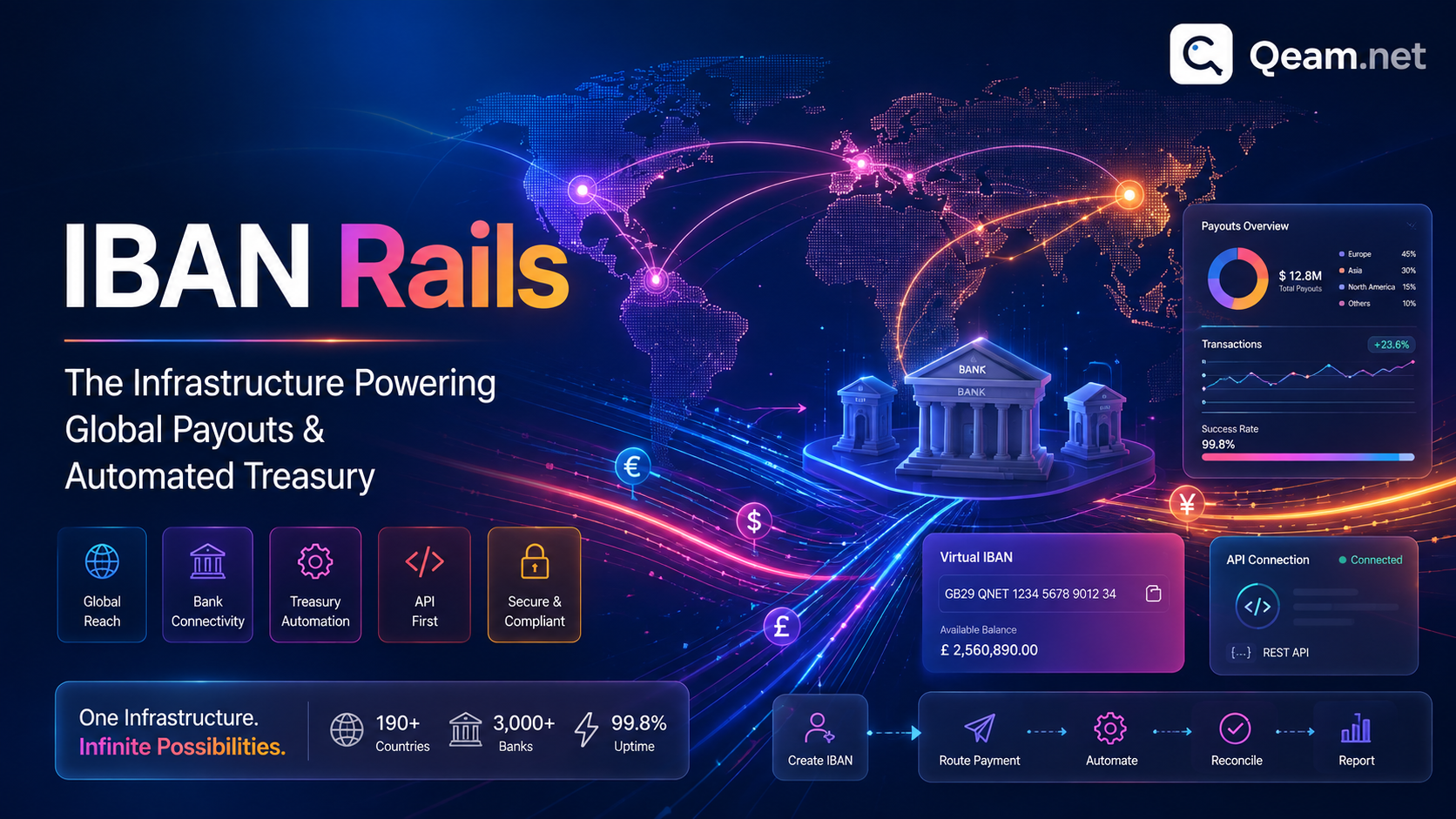
IBAN rails are the banking infrastructure that enables domestic and cross border payments using International Bank Account Numbers (IBANs). They combine payment networks such as SEPA, Faster Payments, SWIFT, and RTGS systems with messaging standards like ISO 20022 and core banking ledgers that route, validate, reconcile, and settle funds.
Modern fintechs no longer treat an IBAN as simply a bank account number. Instead, they treat it as programmable financial infrastructure that can be issued instantly through APIs, assigned to individual customers, monitored in real time, and retired automatically when no longer required.
This shift has transformed treasury operations, marketplace payouts, embedded finance, crypto on and off ramps, and global payroll. Instead of relying on slow correspondent banking chains, businesses increasingly use API driven IBAN rails that offer faster settlement, richer payment data, lower operational risk, and automated reconciliation.
In this guide you'll learn:
how IBAN rails actually work
the architecture behind modern payment infrastructure
direct versus indirect rail participation
how to evaluate providers
enterprise treasury use cases
operational risks
vendor selection criteria
IBAN Rails Explained in 60 Seconds
For readers looking for the quick answer:
An IBAN identifies a bank account.
A payment rail moves money.
Modern IBAN infrastructure combines payment networks, messaging standards, and ledger systems.
API based IBAN platforms automate payouts, reconciliation, treasury, and compliance.
Businesses choose between sponsor bank access and direct participation depending on scale.
Enterprise platforms prioritize redundancy, ISO 20022 support, webhook automation, and operational resilience.
The Anatomy Of A Modern IBAN Rail: A Three-Tiered Stack
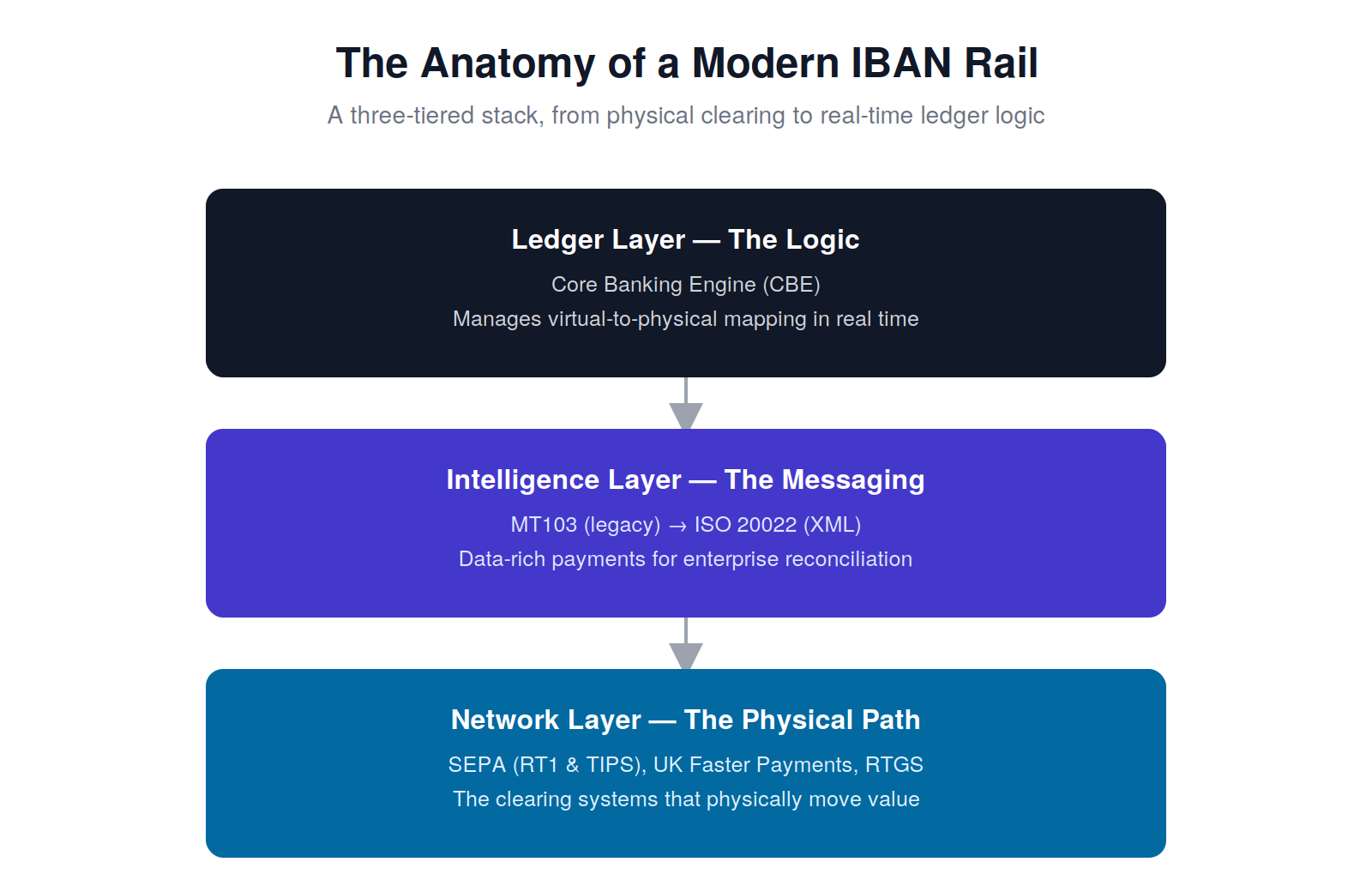
It is helpful to think of an IBAN rail as three layers on top of each other. If you get these layers mixed up. For example if you think the IBAN is the same as the infrastructure. That is where mistakes can happen.
The first layer is the Network Layer. This is the system that clears and settles payments. It includes things like SEPAs payment system, the UKs Faster Payments Service and the systems that central banks use to settle payments in real time. This layer answers the question: how does money actually move from one bank account to another?
The second layer is the Intelligence Layer. This is the messaging system that tells the money where to go. The format of these messages is very important. The industry is moving from a system called MT103 to a new system called ISO 20022. This new system can carry more information, which is important for things like automatic reconciliation and checking for sanctions.
The third layer is the Ledger Layer. This is where the Core Banking Engine lives. It is the system that maps an IBAN to the actual money and tells it what to do. This mapping happens in time and it gives platforms the flexibility to create IBANs like they would create API keys.
Direct Vs. Indirect Rail Access: The Procurement Decision
Every platform that needs IBAN infrastructure will eventually have to make a choice: connect directly to the rails. Go through a sponsor.
Going through a sponsor is faster. A bank or e-money institution gives the platform access to the rails and the platform builds on top of that. But there is a risk: if the sponsor bank has a problem everything that was built on top of it is in trouble. This is the " point of failure" problem that happens in many payments incidents.
Connecting directly means the platform has its Bank Identifier Code and connects to the clearing systems as a principal member. This is more prestigious. It is also more expensive and harder to do. Direct participants have to follow all the rules and regulations. They have to be responsible for the rail itself 24/7.
There are also companies that help platforms connect to the rails. They give the platform one way to connect to many different payment systems.
Most platforms start by going through a sponsor. Then consider connecting directly when their payment volume and complexity get big enough. It is rare for a platform to connect directly from the start.
There is no universal winner.
Choose indirect access when:
launching a fintech quickly
validating product market fit
payment volume is still growing
regulatory overhead should remain low
Choose direct participation when:
annual payment volumes justify infrastructure investment
multiple jurisdictions require independent connectivity
payment resilience becomes business critical
treasury optimization outweighs operational complexity
Many successful payment companies evolve through both stages rather than choosing one permanently.
Comparison: Evaluating IBAN Rail Unit Economics
The costs of using IBAN rails are different depending on the model. These costs add up quickly.
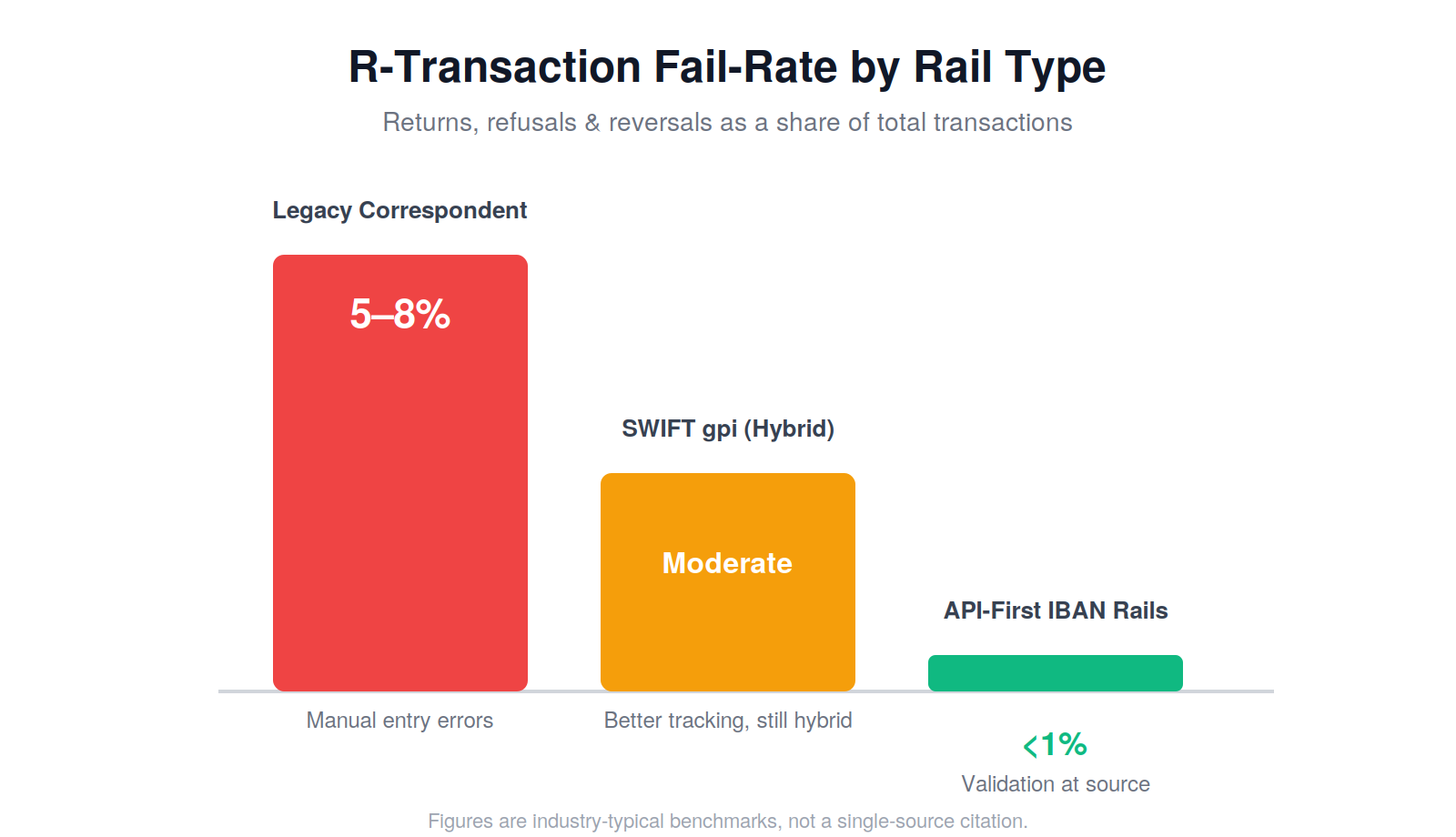
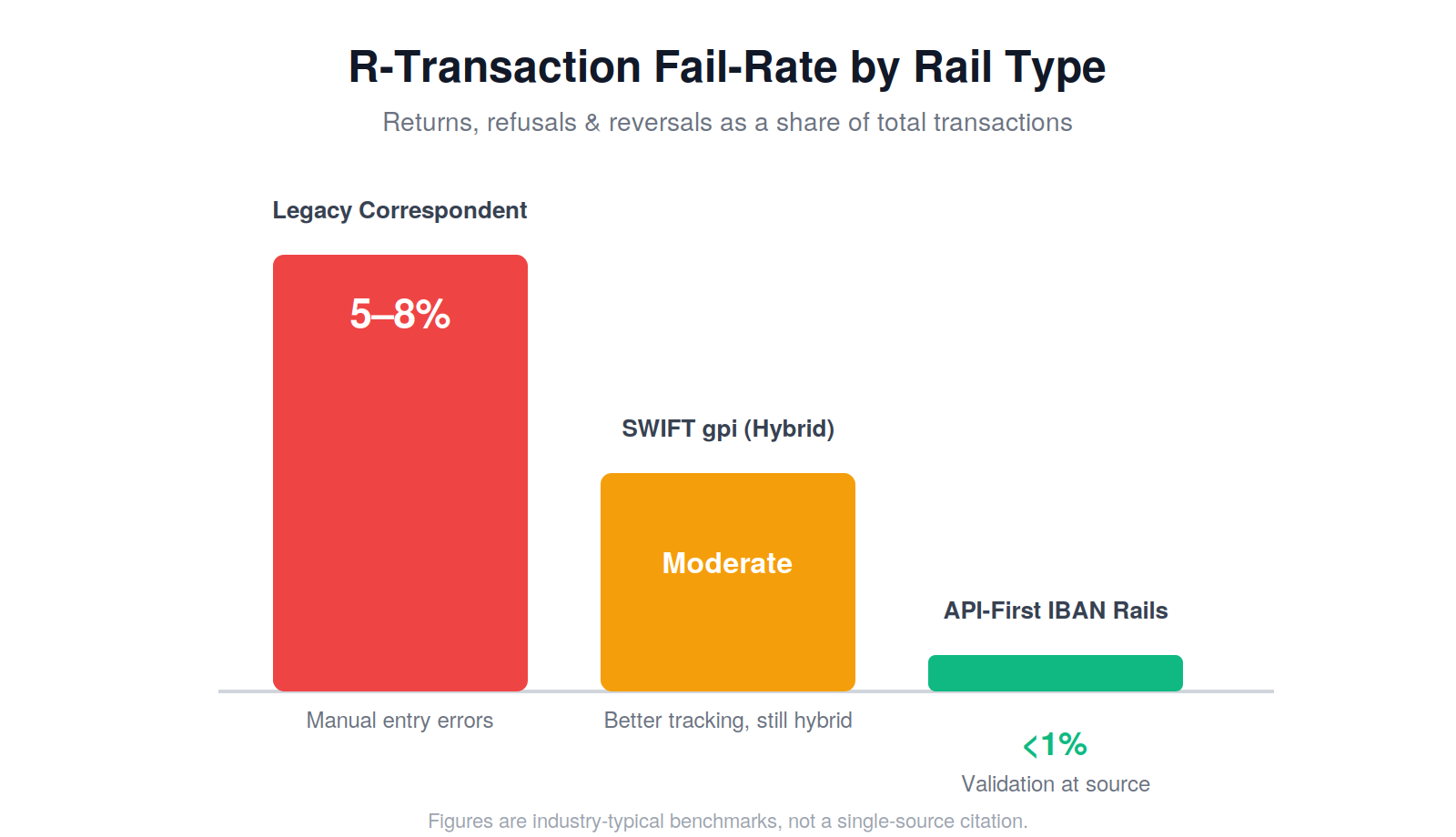
The old way of doing things correspondent banking is slow and unpredictable. Payments take two to five business days to settle. The fees are not transparent. The data can get lost.. The number of failed payments is high. Around 5-8%.
The new way of doing things API-first IBAN rails, is much faster. Payments settle in under 10 seconds. The fees are transparent and fixed. The data is safe. The number of failed payments is very low. Under 1%.
SWIFT gpi is a mix of the two. Payments settle on the day or instantly. The fees are transparent. Not fixed. The data is safe. The number of failed payments is moderate.
The fees can be hard to understand until you have to pay them. API-first rails make it easier because the fees are set when you start, not when the payment is made.
Advanced Enterprise Use Cases
This is where IBAN rails start to look like a tool not just something that is necessary.
Just-in-time funding is one example. Of putting money in an account and letting it sit there platforms can put money in the account at the exact moment a transaction is authorized. This saves money. Makes the platform more efficient.
Multi-currency sweeping and pooling is another example. Platforms can automatically move money between accounts and currencies to minimize costs and maximize efficiency.
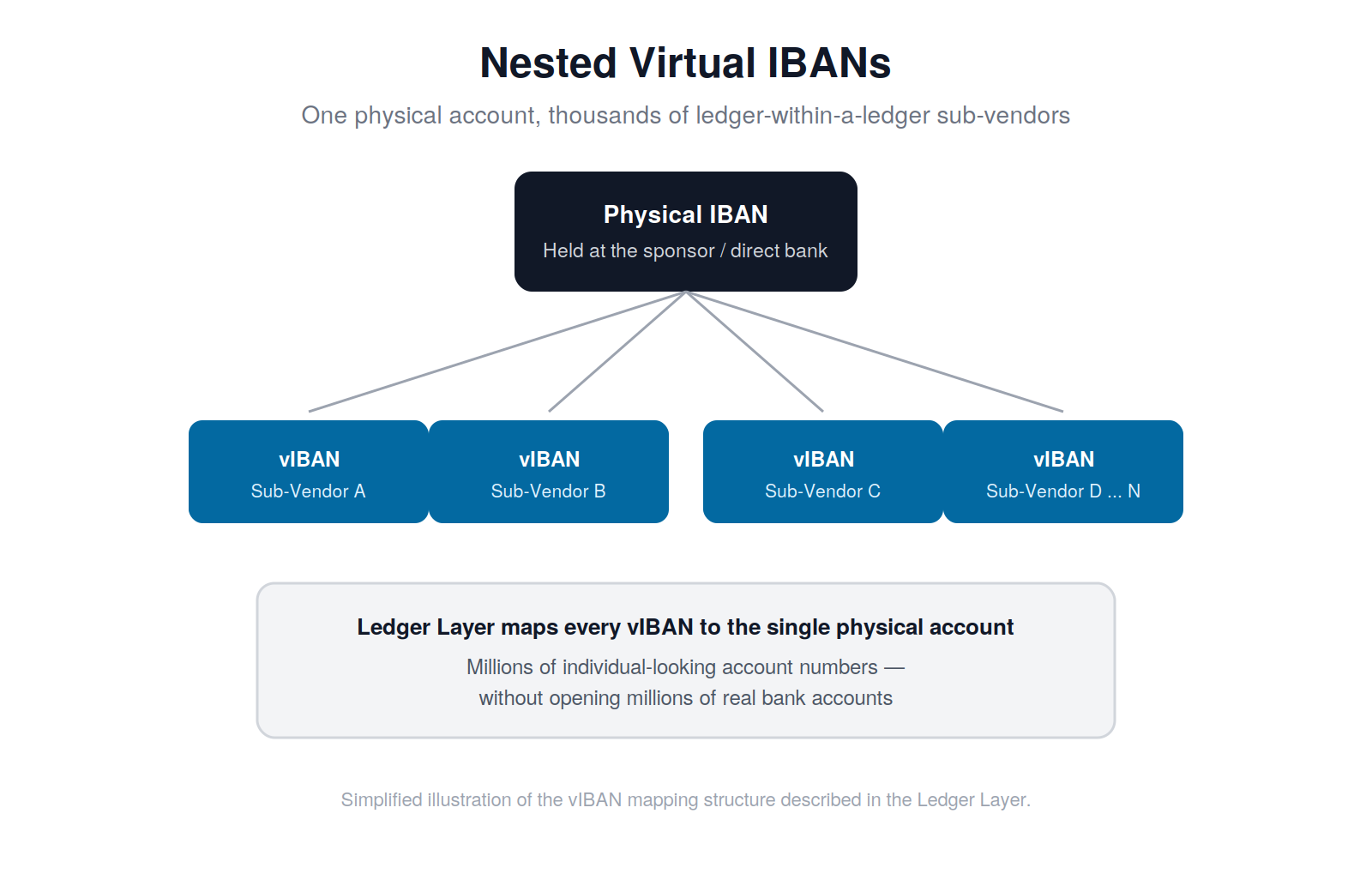
Nested virtual IBANs are also used. Marketplaces can give each vendor their virtual IBAN, which is like a special account number. This makes it look like each vendor has their account but really they are all using the same account.
Closed-loop ecosystems are also possible. Platforms can create their private rail that settles payments instantly between users without touching the outside world. This is the cheapest way to settle payments but it has its own risks.
Operational Resilience: Managing The Fail-States
The "sanctions false positive" trap. Automated screening systems inevitably flag legitimate transactions. The operational challenge isn't avoiding false positives entirely that's not realistic it's building a manual review process that resolves them fast enough that the customer never notices their payment stalled.
Redundancy and failover routing. Serious enterprise platforms maintain relationships with at least two sponsor banks specifically so that a single institution's outage or offboarding decision doesn't take down the entire payment flow. Single-sponsor architectures look fine until the day they don't.
Reconciling the "unreconcilable." R-Transactions Returns, Refusals, and Reversals are the unglamorous but unavoidable byproduct of moving money at scale. Mature infrastructure handles these through automated webhooks rather than manual ops queues, which is the difference between a return being resolved in minutes versus days.
Vendor Selection: 5 Questions For Your RFP
I have a questions about the service. Does the provider support Confirmation of Payee to prevent push payment fraud?
What is the time it takes for the webhook to respond, not the payment time?
Is the International Bank Account Number portable if I change providers or is it tied to that vendor forever?
Does the Application Programming Interface support idempotency keys to prevent payouts when I retry?
What happens to the International Bank Account Number after it expires and what about the funds that are sent after that?
The vendors usually answer the question and do not give clear answers to the rest. I want to know the answers to all of these questions.
Frequently Asked Questions
What is the difference between an International Bank Account Number and a payment system? An International Bank Account Number is like a name. It is a number that points to a specific account. A payment system is like the road that the money travels on. If you have an International Bank Account Number without a payment system it is like having a name without a road to get to the house. The payment system is what makes the International Bank Account Number work.
Do all banks accept International Bank Account Numbers? No they do not. Some old banks and systems do not support International Bank Account Numbers, which can cause problems when the other bank does not know how to send money to them.
How does Instant Single Euro Payments Area affect the money that companies have? By making it possible to move money in seconds of days Instant Single Euro Payments Area lets companies keep less extra money because they can use it right away instead of waiting for it to arrive.
Can I use an International Bank Account Number system to send money to another country? Kind of. The International Bank Account Number system is usually for one country and one type of money. If I want to send money to another country I usually need to use a service that can change the money to the right type.
What is an idempotent payment request? It is a request that is designed so that if I send it twice it only happens once. This is important so that I do not accidentally send two payments of one.
The Programmable Money Era
The idea behind all of this is that money is becoming like a computer program and not just a record in a bank. In the future the bank will be, like a computer program and the payment system will be what makes it work well.
The payment system is what will determine if I can pay someone in ten seconds or five days.I want to know if my current payment system is good enough. I can try out a test system. Ask for a payment system check to see if it works well before it is too late.
Common Mistakes When Choosing IBAN Infrastructure
Organizations frequently underestimate the operational complexity behind payment rails.
Common mistakes include:
selecting providers based only on transaction pricing
relying on a single sponsor bank
ignoring webhook latency
overlooking virtual IBAN portability
failing to test payment retries
treating reconciliation as a manual finance task instead of an automated engineering workflow
Most production payment failures originate from these operational decisions rather than the payment rail itself.
Key Takeaways
Modern IBAN rails are no longer just payment infrastructure. They are programmable financial platforms that combine payment networks, messaging standards, ledger technology, and compliance automation into a unified system.
Businesses evaluating providers should compare far more than transaction costs. Settlement speed, rail redundancy, ISO 20022 support, treasury automation, webhook performance, and operational resilience ultimately determine whether a payment platform scales reliably under enterprise workloads.
Organizations planning embedded finance, global payroll, marketplace payouts, or treasury modernization should evaluate their payment architecture before transaction volumes expose hidden bottlenecks.