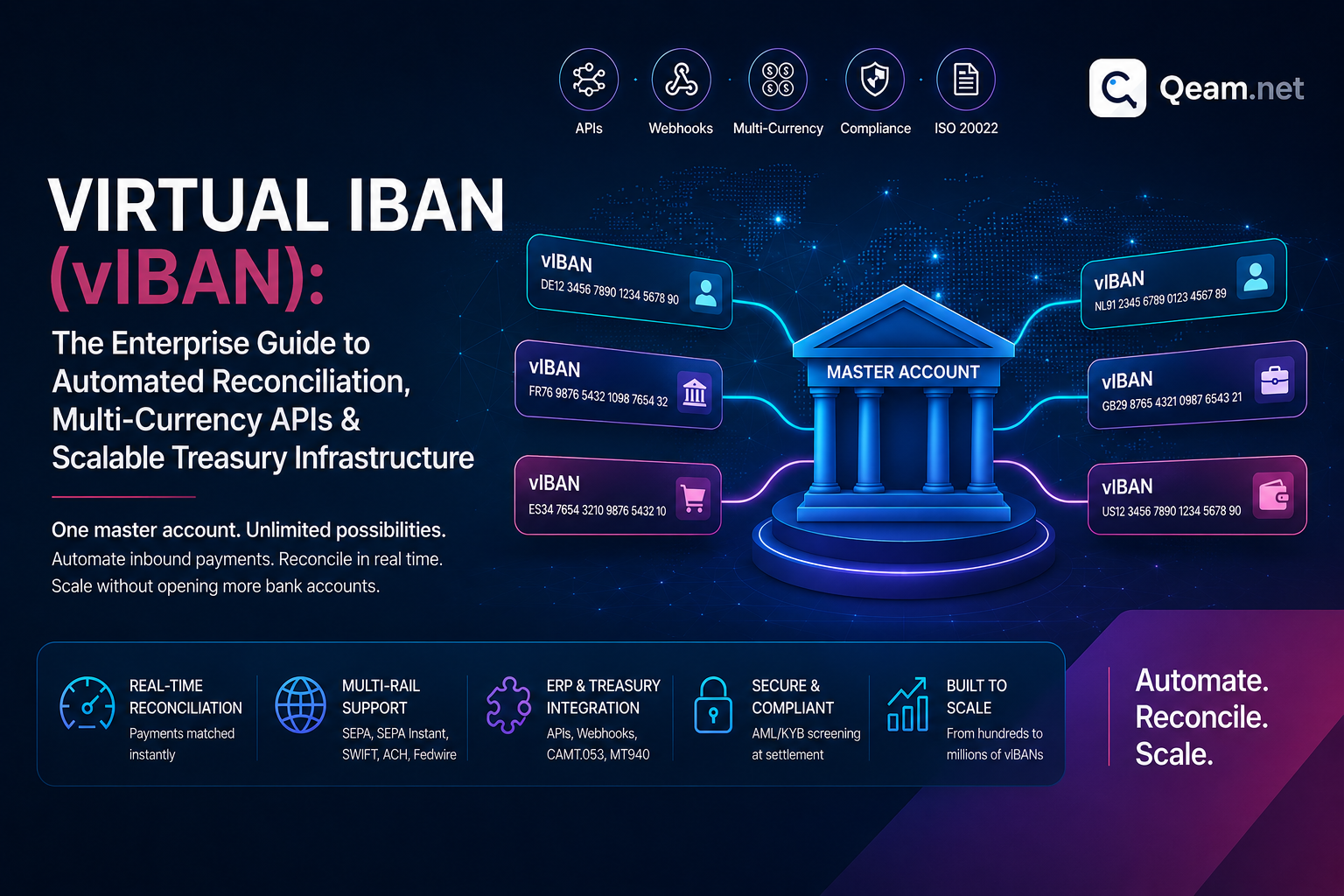
A Virtual IBAN (vIBAN) is a unique payment routing identifier linked to one regulated master bank account. Businesses use Virtual IBANs to assign a dedicated IBAN to every customer, invoice, subsidiary, seller, or wallet while keeping funds consolidated in a single account. This architecture enables automatic payment reconciliation, real time cash visibility, API driven treasury management, and scalable inbound collections without opening thousands of individual bank accounts.
Virtual IBAN infrastructure is widely adopted by fintechs, marketplaces, SaaS platforms, treasury teams, payment service providers, and embedded finance providers that process high volumes of incoming bank transfers.
Key Takeaways
A Virtual IBAN is not a separate bank account. It is a routing identifier linked to one regulated master account.
Every customer, invoice, or subsidiary can receive its own unique IBAN without creating additional bank accounts.
Incoming payments are automatically matched to the correct payer using the destination vIBAN.
REST APIs and webhooks eliminate manual reconciliation.
Virtual IBANs support enterprise treasury, marketplaces, SaaS billing, embedded finance, and digital wallets.
Enterprise platforms commonly support SEPA, SEPA Instant, SWIFT, ACH, and Fedwire.
Static vIBANs are ideal for recurring relationships, while dynamic vIBANs suit one time invoices.
1.0 What Is a Virtual IBAN (vIBAN)? Core Mechanics, Shadow Routing & Master Ledger Architecture
A vIBAN is not a bank account in its own right. It is a routing identifier — a "shadow" IBAN — that sits on top of one real, regulated master account. When a payer sends funds to a vIBAN, the underlying banking infrastructure reads the destination IBAN, matches it against a metadata table (customer ID, invoice number, subsidiary code), and credits the master account while tagging the transaction with that identity. The business never manages multiple balances; it manages one balance and thousands of labels.
This is why vIBAN infrastructure scales so differently from traditional multi-account banking: issuance is a database operation, not a bank-opening process, so a marketplace or SaaS platform can generate a new vIBAN in milliseconds for every new seller or tenant.
1.1 Virtual IBAN vs. Standard IBAN: Core Structural Differences
The distinction that trips up most finance teams evaluating vIBANs is that a standard IBAN represents a real, standalone account with its own balance and statement, while a vIBAN is purely an identification and routing layer sitting above one master account.
Attribute Standard IBAN Virtual IBAN (vIBAN)
Holds its own balance Yes No — funds settle in the master account
Issuance speed Days (manual account opening) Seconds (API call)
Typical volume per business 1–10 accounts Hundreds to millions
Bank statement One statement per account One consolidated statement, tagged by vIBAN
Best suited for Core operating accounts Per-customer, per-invoice, or per-tenant attribution
Reconciliation method Manual reference matching Automated, payer-identified via routing tag
1.2 How Virtual IBAN Payment Routing Works
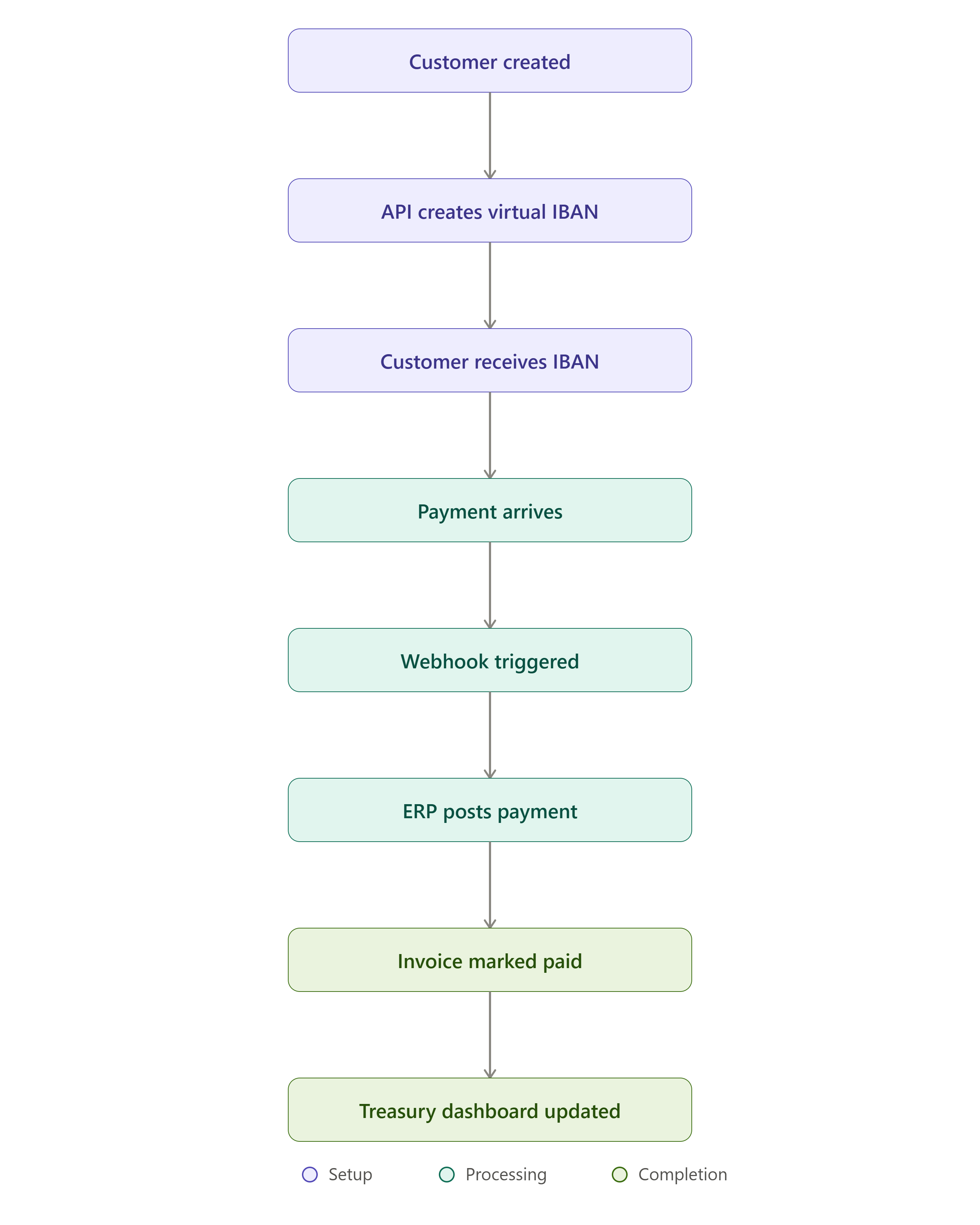
Every inbound payment follows five predictable steps:
A unique Virtual IBAN is assigned to a customer, invoice, seller, or subsidiary.
The payer transfers funds to that Virtual IBAN using SEPA, SWIFT, ACH, or Fedwire.
The issuing institution maps the destination Virtual IBAN to the underlying regulated master account.
Funds settle into the master account while preserving the Virtual IBAN identifier and payment metadata.
APIs or webhooks immediately notify ERP, treasury, or accounting systems, allowing automatic reconciliation without manual intervention.
Because reconciliation is based on the destination Virtual IBAN rather than free text payment references, businesses significantly reduce unmatched payments and manual investigation.
1.3 Static vs. Dynamic Virtual IBANs: Permanent Sub-Accounts vs. Single-Use Invoice References
Not every vIBAN behaves the same way, and choosing the right type matters for lifecycle management:
Static vIBANs are assigned permanently to a customer, seller, or subsidiary and remain active for the life of that relationship — ideal for recurring billing or ongoing marketplace payouts.
Dynamic vIBANs are generated for a single transaction (typically one invoice) and retired once payment is received, which keeps the routing table lean and simplifies matching for one-off or irregular payments.
A useful rule of thumb: assign static vIBANs to any entity that will receive recurring payments, and dynamic vIBANs to anything tied to a single invoice or order.
Why Enterprises Prefer Virtual IBAN Infrastructure
Traditional reconciliation relies on payment references entered manually by customers. These references are often incomplete, incorrect, or missing altogether, forcing finance teams to investigate transactions one by one.
Virtual IBANs eliminate this dependency by embedding customer identity directly into the payment destination rather than the payment description. Every transfer already contains the identifier needed to reconcile it.
As transaction volumes increase, this architecture allows finance operations to scale linearly through automation instead of additional reconciliation staff.
2.0 Enterprise Virtual IBAN Features: Programmatic REST APIs, Webhooks & Multi-Rail Clearing
Enterprise vIBAN infrastructure is judged less on the concept and more on how programmable it is. The features that separate a genuinely operational platform from a marketing page are issuance control, event-driven notifications, multi-currency rail coverage, and compliance automation.
2.1 Unlimited Programmatic Issuance & Lifecycle Control
vIBANs should be issuable, labelled, paused, and retired through documented REST endpoints — not a support ticket. A platform onboarding thousands of sellers or tenants needs to create a vIBAN the instant a new account is verified, tag it with internal metadata, and deactivate it automatically if the relationship ends.
2.2 Real-Time Webhook Event Triggers & API Ledger Attribution
Webhooks are what make reconciliation "automated" rather than "faster." When a payment settles on a vIBAN, the platform should dispatch a structured event (commonly something like inbound_payment.received) containing the vIBAN reference, amount, currency, originator details, and timestamp — allowing the receiving ERP or ledger to post the entry without any manual review.
2.3 Multi-Currency Rail Support (EUR SEPA Instant & USD Fedwire/ACH)
A single-currency vIBAN offering is a limitation, not a feature, for any business collecting payments across regions. Enterprise-grade coverage typically spans EUR via SEPA and SEPA Instant Credit Transfer (SCT Inst) — with settlement often completing in under 10 seconds — alongside USD collections via ACH and Fedwire, and cross-border transfers via the SWIFT network, giving finance teams one reconciliation model across multiple rails instead of a patchwork of regional banking relationships.
2.4 Built-In AML & KYB Screening at Settlement Instant
Because every vIBAN payment ultimately lands in a regulated master account, inbound funds are screened against sanctions and AML rules the moment they arrive — not in a batch review days later. This originator-level screening is what allows regulators to treat vIBAN routing as a compliant extension of the underlying regulated account, rather than an unregulated workaround.
2.5 ISO 20022 & CAMT.053 Compatibility: Bridging Real-Time APIs with Legacy ERP Statement Reporting
Not every finance team consumes data through an API. Many still run reconciliation through scheduled statement imports into SAP, NetSuite, or Microsoft Dynamics. Enterprise vIBAN infrastructure should therefore support both ISO 20022 messaging for real-time processing and traditional CAMT.053 XML or MT940 statement exports, so legacy ERP workflows can ingest the same tagged, reconciled data without custom middleware.
3.0 Who Needs Virtual IBANs? Enterprise Business Use Cases
The value of vIBANs is easiest to see in the businesses that receive high volumes of inbound payments from many distinct counterparties.
3.1 Multi-Vendor Marketplaces: Seller Settlements & Escrow Sub-Accounts
Example: A marketplace with 4,000 active sellers issues each one a static vIBAN. A buyer pays for an order, the vIBAN attributes the payment to the correct seller, and the funds are held in an escrow-style sub-ledger until the order is confirmed delivered — at which point the seller's payout is released, without finance staff manually tracing a single transfer.
3.2 B2B SaaS & Subscription Platforms: Per-Tenant Automated Billing
Example: A SaaS company issues a dynamic vIBAN for each annual enterprise invoice. When the customer's finance team pays via bank transfer instead of card, the payment lands, is matched to the invoice ID embedded in the vIBAN, and the subscription is activated automatically — closing a gap that otherwise forces manual invoice chasing.
3.3 Corporate Treasury Teams: Subsidiary Tagging & Inter-Company Liquidity
Example: A corporate group with subsidiaries and rental properties across several countries assigns each entity a static vIBAN. All collections consolidate into one master account, giving the treasury team a single real-time liquidity view while inter-company transfers remain individually tagged for audit purposes.
3.4 Fintech & Embedded Banking (BaaS): Programmatic vIBANs for End-User Digital Wallets
Fintechs building wallets or neobank-style products on top of a Banking-as-a-Service (BaaS) layer use vIBANs to give each end user their own receiving IBAN — without the fintech needing its own banking license, since the underlying master account and safeguarding sit with the regulated partner institution.
4.0 Without vs. With Virtual IBAN Infrastructure: The Reconciliation Impact
Operational Metric Without Virtual IBANs With Virtual IBAN Infrastructure
Payer identification Manual reference matching, error-prone Automatic, tied to the vIBAN used
Reconciliation speed Hours to days per batch Real time, on settlement
Staffing overhead Dedicated reconciliation headcount Minimal — exception handling only
Scalability Constrained by manual review capacity Scales with API issuance, no per-account ceiling
Cash visibility Delayed, batch-based Live, as payments settle
Error/mismatch rate Higher, driven by free-text references Near-zero, driven by structured routing
5.0 Step-by-Step Implementation Guide: Integrating Virtual IBAN APIs
Step 1 — Open and verify a master account. The underlying corporate IBAN is opened with a regulated EMI or partner bank, subject to standard KYC/KYB checks.
Step 2 — Issue vIBANs programmatically. Through the REST API, generate a vIBAN per customer, invoice, or subsidiary and attach the relevant metadata tag.
Step 3 — Subscribe to webhooks and reconcile. Listen for payment events, map the vIBAN reference to the internal record, and post the entry automatically in the ledger or ERP.
Inbound Refund Routing, Exception Handling & Failed Transfer Recovery
Not every payment matches cleanly. When a transfer is sent to a retired vIBAN, fails compliance screening, or is misdirected, a mature platform automatically returns the funds to the originator and dispatches an exception event — for example a rejected-transfer notification — so the finance team can see and resolve the mismatch without digging through raw bank statements.
6.0 Frequently Asked Questions
How are vIBANs different from a normal IBAN? A normal IBAN represents its own bank account with its own balance. A vIBAN is a routing layer with no balance of its own — every payment it receives settles into one shared master account, tagged to identify the payer.
How many vIBANs can a business issue? There is generally no fixed ceiling; vIBANs are issued programmatically, so a business can generate as many as its customer, invoice, or subsidiary base requires — from dozens up to millions.
Which currencies are typically supported for Virtual IBANs? Enterprise vIBAN providers commonly support EUR via SEPA and SEPA Instant, with USD collections available through ACH and Fedwire, plus SWIFT for broader cross-border coverage.
Can a vIBAN be retired or deactivated after payment? Yes. Dynamic, single-use vIBANs are typically retired automatically once the associated invoice is paid, while static vIBANs can be deactivated on request when a customer or subsidiary relationship ends.
Is there a webhook notification for inbound vIBAN payments? Yes — enterprise platforms dispatch a structured webhook event as soon as a payment settles on a vIBAN, carrying the amount, currency, originator details, and the vIBAN reference for automated posting.
What is the difference between static and dynamic vIBANs? Static vIBANs are assigned permanently to an ongoing relationship, such as a subscriber or subsidiary. Dynamic vIBANs are generated for a single invoice or transaction and retired once that payment is received.
What happens if a transfer is rejected or sent to an inactive vIBAN? The funds are automatically returned to the originating account, and an exception webhook is dispatched so the finance team can review and resolve the mismatch without manual bank statement tracing.
Can Virtual IBAN data be imported into legacy ERP systems like SAP or NetSuite? Yes. In addition to real-time API and webhook access, most enterprise vIBAN platforms export CAMT.053 XML or MT940 statement files compatible with SAP, NetSuite, and Microsoft Dynamics.
Are Virtual IBANs safe and compliant for business payments? Yes. vIBANs route into master accounts held by regulated EMIs or partner banks, with client funds safeguarded under applicable EU or US frameworks and inbound payments screened for AML and sanctions compliance at settlement.
Who typically uses Virtual IBAN infrastructure? Marketplaces (seller settlements and escrow), SaaS platforms (per-tenant billing), corporate treasury teams (subsidiary and rent collection), and fintechs building embedded banking products on a BaaS layer.
7.0 Related Infrastructure
Virtual IBANs work alongside a broader banking stack: a corporate IBAN provides the underlying master account, an IBAN rail connects that account to global clearing networks, and a Banking-as-a-Service (BaaS) layer lets fintechs issue vIBAN-backed wallets to their own end users without holding a banking license.
Common Virtual IBAN Implementation Mistakes
Organizations evaluating Virtual IBAN platforms should avoid:
Treating Virtual IBANs as independent bank accounts.
Relying only on manual payment references.
Choosing providers without webhook support.
Ignoring ERP integration requirements.
Creating static Virtual IBANs for one time invoices.
Using dynamic Virtual IBANs for long term customer relationships.
Overlooking ISO 20022 and CAMT.053 compatibility.
8 Conclusion
Virtual IBANs transform inbound payment operations by replacing manual reconciliation with automated payment attribution. Instead of managing hundreds or thousands of separate bank accounts, businesses operate a single regulated master account while assigning a dedicated routing identity to every customer, invoice, seller, or subsidiary.
For fintechs, marketplaces, SaaS platforms, treasury teams, and enterprises processing large payment volumes, this architecture delivers faster reconciliation, improved cash visibility, simplified treasury management, and infrastructure that scales through APIs rather than manual operations.
As real time payments, ISO 20022 messaging, and embedded finance continue to expand globally, Virtual IBAN infrastructure is becoming a foundational component of modern enterprise payment systems rather than an optional optimization.